


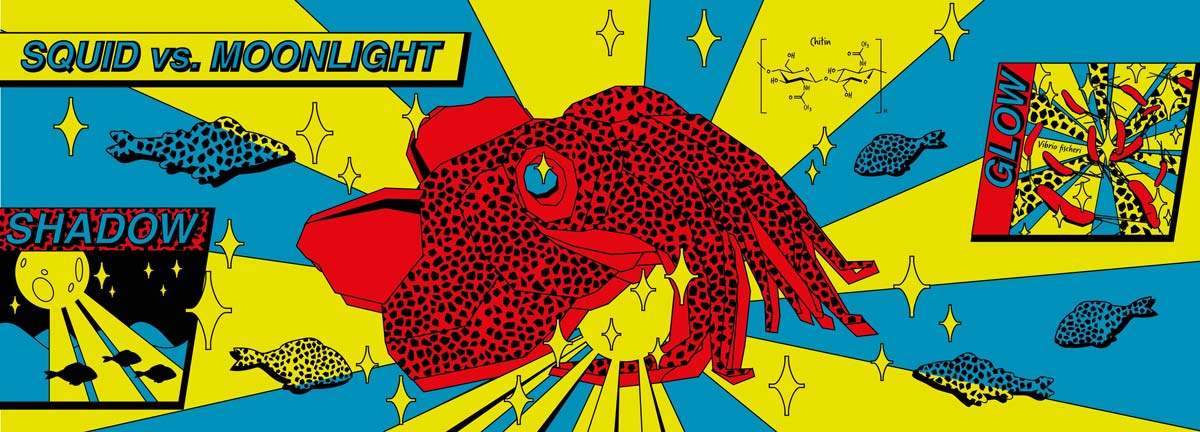
Squid vs moonlight
Bringing brightness to the night’s ocean
Bobtail squids of the Euprymna scolopes species are small, nocturnal sea creatures found mainly in tropical coastal regions, which – despite their diminutive size – play a remarkable role in the ocean. What’s particularly impressive is the partnership they have formed with the light-producing bacteria Aliivibrio fischeri that quite literally give them a cloak of invisibility.
This symbiotic relationship shows how closely organisms can cooperate with one another. While many sea creatures rely on speed or armour to stay safe, the Euprymna uses bacterial bioluminescence as its defence mechanism – a strategy that is as elegant as it is effective.
Networking at its best
The Hawaiian bobtail squid only grows to a few centimetres in length and has a compact, round body with eight arms and large eyes. They are nocturnal, spending the day hiding in the sand, before leaving their hiding place at twilight to go hunting for shrimp in the shallow waters.
On moonlit and starry nights, however, they would be easily visible, casting a silhouette against the moonlight or a shadow on the seabed. This means they would soon be spotted both by larger predators and by their own prey. And this is where they play their master stroke – their symbiosis with the Aliivibrio fischeri bacteria. Together, the squid and bacteria make a small but extremely effective super team of nature, perfectly adapted to life in the ocean after dark.
Light acting as camouflage
The Euprymna conceals its symbionts in a special body cavity called the light organ. It chooses its microbial partners very carefully and does not accept any bacteria other than A. fischeri, which is capable of bioluminescence. To stimulate the bacteria’s bioluminescence, the squid synthesises chitin in the light organ as night begins to fall. This causes acidification of the tissue, which increases the oxygen content, thereby supporting the development of bioluminescence by the Aliivibrio bacteria.
The light generated by the bacteria is distributed through the special anatomy of the light organ, not in the squid’s body, but rather through its skin a bit like a torch, shining light onto the ocean floor. When an Euprymna then swims in open water, its silhouette is now invisible to predators below. This is because the squid, who would otherwise form a dark silhouette against the moonlight, is not dark but instead light, and therefore blends in with the moonlight – a trick known as countershading. If, however, the miniature squid stays close to the seabed, its bioluminescence will brighten up its shadow against the ocean floor, so it can remain undetected by its prey. On darker nights, when the animal’s light would give the squid away rather than protect it, the Euprymna can even close its light organ, in effect “switching the light off”.
Symbiosis of the highest order
The relationship between the bobtail squid and Aliivibrio fischeri is not a matter of chance, but rather an enduring and highly specialised partnership. The squid provides the bacteria with nutrients and creates a stable and protected environment for it. In return, the bacteria provide light, affording the host protection and camouflage when it goes hunting.
This finely coordinated interplay is a win-win situation in the truest sense: without the bacteria, the squid would be easily visible on bright moonlit nights, and the bacteria enjoy an all-you-can-eat buffet from the comfort of optimum conditions inside the light organ – at least for one night anyway. That is because, in 95% of cases, the Euprymna kicks the bacteria out of its light organ by the morning. Perhaps the bacteria bother it, or have a harmful long-term effect or perhaps they are simply drained – researchers do not yet know the exact reasons for this daily clear out.
Research and laboratory work
Researchers have been exploring the symbiosis between Euprymna and Aliivibrio to learn how microorganisms target their hosts, how the host controls the structure of its bacterial partners and how stable symbioses endure over long periods. The bobtail squid is regarded as an important model organism for researching these types of symbiotic relationship, because the interdependencies between the animal and the bacteria are clearly defined in spatial terms and precisely controlled in biological terms. Such research focuses on molecular signal processes, such as what’s known as quorum sensing, a type of communication between bacteria, which they use to control their gene activity, for example, depending on cell density. This is especially interesting, because similar symbioses can be seen in human and animal microbiomes, such as in the gut or on the skin.
For research into symbioses or bioluminescence and any other demanding experiments, the Carl ROTH Shop has a range of premium materials and reagents: www.carlroth.com
Sources:
https://scilogs.spektrum.de/meldung-vom-meer/zwergtintenfische-mit-leuchtsymbiose
https://carlroth.blog/schoenerwohnen
M. McFall-Ngai 2014, PLoS Biology, doi 10.1371/journal-pbio.1001783
J. Schwartzman et al. 2014, PNAS doi 10.1073/pnas.1418580112
https://www.spektrum.de/magazin/wie-ein-tintenfisch-leuchtbakterien-fuer-tarnzwecke-nutzt/1422606