



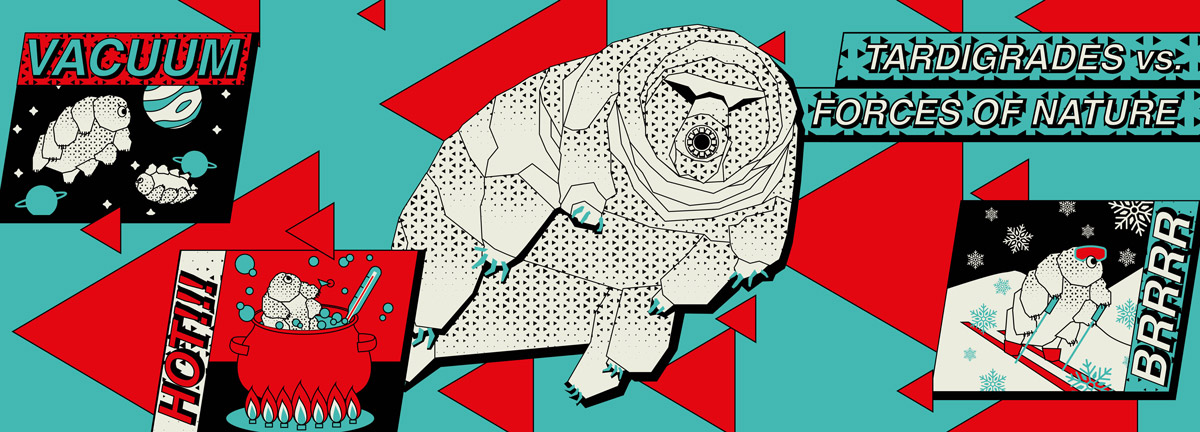
Water bears vs the forces of nature
The guardians of genes
Water bears, also known as tardigrades, are microscopically small arthropods that offer an impressive example of how life can still survive in extreme conditions. They are found the world over, from temperate climates to polar regions and even deep ocean trenches. They feed off algae, bacteria and other microorganisms. Despite their miniscule size, they play a vital role in ecosystems, and have even come to be considered an important model organism in the world of scientific research.
The tardigrades’ impressive resilience makes them a fascinating object of study for scientists researching stress resistance, DNA repair mechanisms and long-term survival. Studies into these tiny creatures provide discoveries that go far beyond biology and in fact open up applications in medicine, biotechnology, conservation and even space exploration. Their ability to survive in extreme environmental conditions offers valuable insights into fundamental biological processes that are vital for the stability and durability of cells.
Who are these tiny creatures?
Most water bears are between 100 and 500 micrometres in size, only a few of the 1300 identified species reach lengths of up to 1.5 millimetres. With eight short legs and a stocky body, they almost appear a little ungainly under the microscope. They have adapted to many different habitats, from mild and temperate moss cushions to extreme environments such as glacial ice. Since they are hugely resistant to dehydration, they can even be found in desert regions, albeit in an inactive state, because all water bears require a thin film of water to remain active.
Despite their diminutive size, tardigrades are highly complex organisms. Their physique is optimised for survival in harsh conditions: they have special cells and structures that enable them to regulate their water balance, cell structure and metabolic processes even in the most adverse conditions.
Cryptobiosis: adapting to extreme conditions
One of the most fascinating attributes of water bears is their ability to enter into a state called cryptobiosis. In this state, water in the organism’s body is replaced by cryoprotective substances such as the sugar trehalose and metabolic activity is all but completely stopped. In this state, water bears can withstand extreme conditions that would be fatal for most life forms: dehydration, extreme heat or cold, chemical stress and, in the short term, even a vacuum. As soon as they are surrounded by liquid water once again, tardigrades can return to a fully active state after months, years or even decades in cryptobiosis.
Water bears in research
Researchers use tardigrades as a model organism to investigate fundamental mechanisms of stress resistance, DNA repair and protein stabilisation, which are vital for the long-term survival of cells.
The DNA-associated protein Dsup (damage suppressor), found only in water bears, plays a vital role in protecting the creatures against radiation damage and in their tolerance of oxidative stress. Tardigrades can withstand up to 1000 times more radioactive radiation than other animals. Dsup binds to the nucleosomes in the cell nucleus, where it prevents radiation from breaking DNA. When a laboratory experiment genetically changed human HEK293 cells so that they expressed Dsup protein, these cells showed around a 40% increase in tolerance to X-ray radiation. After the application of hydrogen peroxide, these Dsup+ cells activate the detoxification system and the antioxidative enzymes to remove oxidative free radicals and oxidative stress, while repair mechanisms restore damaged proteins and cell structures.
The findings from this research have been put into effect in real-world applications: in biotechnology, this knowledge helps to stabilise sensitive cell cultures and allows vaccines or biological samples to be transported safely. In medical fields, the findings act as a catalyst for strategies to improve the resistance of tissues and organs to oxidative stress or radiation. When it comes to preserving biological samples or the long-term storage of museum specimens, the mechanisms demonstrated by water bears are once again of vital importance.
Their ability to endure exposure to extreme radiation also makes them a fascinating model for future space exploration missions and for developing strategies to protect astronauts. Their cryptobiosis, namely their ability to survive a long time in a sleep state, could provide the starting basis for discovering how people could be placed in a similarly dormant state – whether for medical reasons or for space exploration. In this way, they bring basic research together with practical applications and show how insights from nature can be fed directly into innovative scientific concepts.
Discover the right laboratory equipment for your research
Whether you work with microscopically small organisms like water bears and cells or you are planning some experiments in the field of biotechnology, Carl ROTH has premium tools, reagents and consumables for every laboratory requirement. Visit our online store to explore the range of products: www.carlroth.com
Sources:
https://www.wissen.de/baertierchen-die-unzerstoerbaren-winzlinge
http://wissenschaft.de/erde-umwelt/baertierchen-geben-gen-geheimnisse-preis/