



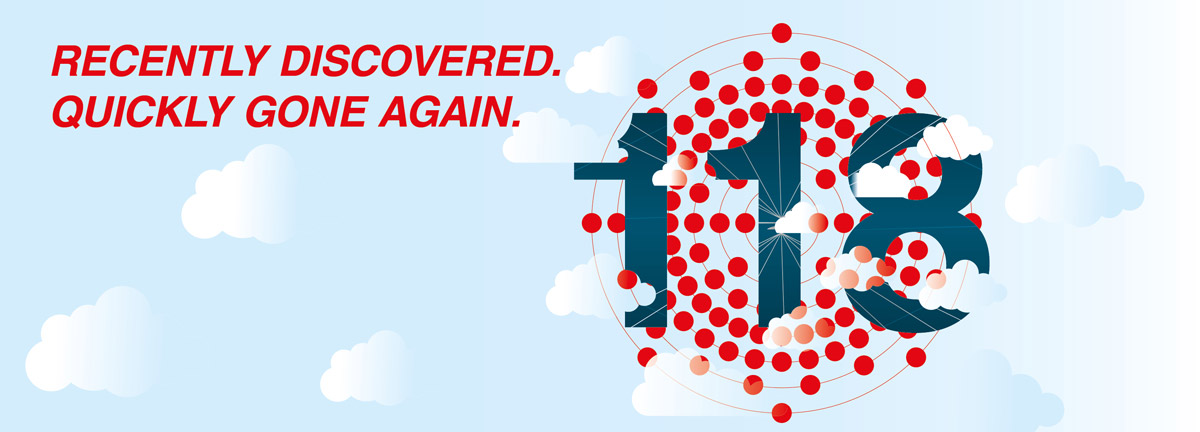
The element oganesson
Discovered recently, visible only for a moment
Oganesson, the latest and heaviest addition to the periodic table of elements, is a chemical and physical paradox. The synthesised element is classified as a noble gas, yet its composition and chemical behaviour contradict many of the characteristics that define this group of elements: researchers assume that, like its fellow noble gases, oganesson exists in a gaseous state at room temperature. However, theoretical calculations also show that under certain conditions, its electrons could take on metallic properties due to relativistic effects, causing oganesson to become solid.
Its anomalies in terms of matter, binding energies, electron density and chemical reactivity make oganesson an exciting and noteworthy subject of research for scientists.
Oganesson – a rare element in the periodic table
The element with the atomic number 118 is the heaviest of all known elements to date and exists for barely longer than the blink of an eye. It is the first superheavy noble gas atom to complete its element group – for the time being. Oganesson was only added to the periodic table in 2016, together with three other elements: nihonium, moscovium and tennessine. All four are at the end of the seventh period and have one thing in common – they do not occur naturally. Although the possible existence of oganesson was predicted many years ago by theoretical models, it could only be produced using sophisticated experimental techniques.
Manufactured under extreme conditions
Oganesson is produced by nuclear fusion. Researchers typically use a particle accelerator to collide lighter ions with heavy target material in a controlled manner. In a typical experiment, calcium-48 ions are fired at californium-249 atoms. This can cause the atomic nuclei of both elements to fuse and form the new, superheavy element oganesson. What sounds simple in theory is, in practice, a complex manufacturing process that can take several months. And the probability of the fusion ultimately succeeding is extremely low. To make matters worse, oganesson’s half-life is so short that further chemical experiments and investigations are virtually impossible. As soon as it is produced, oganesson emits an alpha particle in less than a millisecond and decays into livermorium.
Puzzling structure: unusual shell structure and electron distribution
The turning point came when a New Zealand research team led by Paul Jerabek from Massey University in Auckland used quantum physics models and calculations to gain deeper insight into the atomic structure of oganesson for the first time. The scientists used Fermi localisation to do this. This method enabled them to calculate the spatial relationship between the oganesson electrons, their spins and their interaction. The conclusion was that the electron arrangement of oganesson differs fundamentally from that of other, lighter elements. Normally, electrons move within the atom in so-called orbitals, places where they are most likely to be found. In oganesson, this familiar structure dissolves outwards: the electrons in the outer region of the atomic shell are distributed diffusely and evenly in this element, comparable to a gas-like cloud.
Electromagnetic interactions and diffuse atomic nucleus
Among the reasons for the breakdown of order are two effects that occur inside the oganesson atom: in superheavy elements, the Coulomb forces grow so strong that relativistic effects come into play, reducing the stability of the atom. The electrons inside move so fast that the spin-orbit coupling is affected, which changes the entire electron structure: the electrons can no longer be clearly localised. The atomic nucleus of oganesson is also remarkably different. The 118 protons and 176 neutrons in the nucleus lead to special interactions that also cause the nuclear particles to enter a diffuse, quantum physical state in the form of Thomas-Fermi gas.
All the findings gathered about the diffuse electron distribution, the easily changeable charge distribution and its “dipole ability” indicate that oganesson is more reactive than its other noble gas counterparts and can potentially become solid at room temperature.
Oganesson is a borderline element in the periodic table
Due to its short half-life and complex production process, oganesson is not suitable for practical applications. Nevertheless, this synthetic element is of enormous value to scientific research: with its 118 protons, oganesson is a borderline element in the periodic table, pushing the limits of what is currently known about atomic stability, element affiliation and chemical predictability and putting them to the test. Its electrons move so fast that relativistic effects could lead to behaviour that would not be consistent with either noble gases or metals.
Conclusion: synthetic elements are important for researching heavy materials
Despite its brief and fleeting existence, researchers can use oganesson to test existing theories about nuclear structure, electron shell structure and the stability of matter under extreme conditions, as well as refine models of electron behaviour in superheavy elements.
To discover the unknown, Carl ROTH equips you with aids for all aspects of research and laboratory work. Please visit our online shop: www.carlroth.com
Sources:
https://www.scinexx.de/news/technik/element-118-ist-ein-exot
https://www.samaterials.de/blog/oganesson-element-properties-and-uses.html
https://pro-physik.de/nachrichten/superschwer-und-seltsam
https://www.spektrum.de/periodensystem/oganesson/1624074
https://www.internetchemie.info/chemische-elemente/oganesson.php