

Biofuel of the future?
Green hydrogen from algae
They may be tiny, but they have already achieved great things.
Some 2.5 billion years ago, it was microalgae that introduced oxygen into the atmosphere through oxygenic photosynthesis, and in doing so lay the very foundations for life on earth today. A few years ago, these single-cell organisms were back in the spotlight of scientific research. Certain green algae are considered as future providers of energy – a hard currency in times of climate change and changing energy policies. This is because in a specific set of circumstances, the multi-talents are able to adjust their metabolism such that they can independently produce hydrogen (H2).
Production: current situation
The search for climate-neutral energy sources is one of the greatest technological challenges of the 21st century. Hydrogen is considered a high-potential option, especially because it can be stored, it can be used without producing emissions and it is suitable for industry, transport and power supply. The crux of the matter, however, is that the hydrogen in production today is largely manufactured from fossil sources, primarily by means of steam reformation of methane with the addition of steam measuring between 700 and 1000 °C in temperature [1]. Not only is this not carbon-neutral, but it is also energy-intensive, making it far from ideal. Add to this the fact that the hydrogen currently produced this way simply would not suffice for more widespread use within the transport sector, for instance.
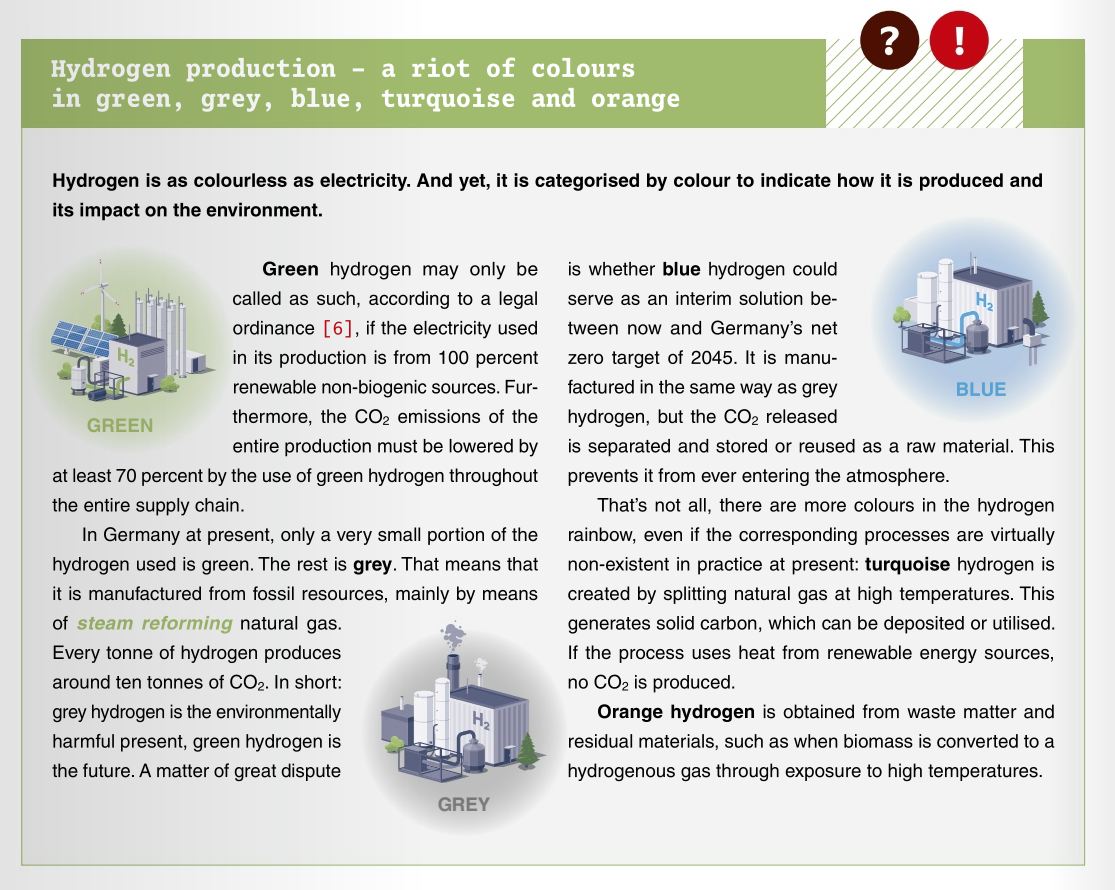
Green hydrogen, which is generated using renewable sources, is therefore in greater demand than ever and is a source of great hope for the energy revolution. The simplest way to it is just water. This is because, the addition of energy can split water into hydrogen and oxygen [2]. This means it needs an energy source, which in this case can be electric, thermal or (bio)photonic in nature [3].
Far and away the most common and frequent method currently used to produce green hydrogen is electrolysis. This involves using energy from renewable energy sources to split water into its constituent parts. Though the process itself is carbon-neutral, it is still very energy-intensive and expensive [4].
Another method is thermochemical water splitting or thermolysis, which uses the waste heat from nuclear or chemical reactions [5,6]. The decomposition process requires temperatures in excess of 2000 °C to guarantee the separation of the elements [2], making it another enormously energy-intensive method. Photoelectrolysis or photoelectrochemical water splitting, on the other hand, uses solar energy and photocatalysts to split water into its elements [7]. Not least, however, the slow reaction kinetics significantly limit the efficiency of this process [8].
That just leaves biophotolysis. This sees microorganisms such as microalgae splitting water with the aid of energy from sunlight. This technology is still in the development stage [2]. But, couldn’t microalgae be responsible for yet another major turning point? Maybe even save the world? Some say “yes”, while others say “maybe”. And others say simply “no”.
Challenges: a sensitive enzyme, a high benchmark
The technology certainly shows potential worthy of further scientific research. It has been and is still the subject of intensive research. The green algae called Chlamydomonas reinhardtii is widely considered a natural talent in terms of biohydrogen production. It was more than 80 years ago that researchers discovered that these single-cell algae, deprived of nutrients, or specifically sulphur, and kept in anaerobic conditions, are able to convert their photosynthesis from producing oxygen to producing hydrogen. In 1993, Professor Thomas Happe from the Ruhr University Bochum, who is still regarded as one of the world’s leading researchers of algae, successfully singled out the enzyme responsible for hydrogen production, namely hydrogenase [9].
So far, so theoretically simple? Could vast water tanks filled with microalgae be the answer to our energy problem, by producing a regenerative fuel from sunlight and water? This concept may be theoretically conceivable, but in practical terms it is not yet feasible. This is down to the vast spatial requirements of such tanks, alongside the hydrogen yield that is still far too low, the growth requirements of the algae and the risk of contamination [4]. But the greatest underlying problem is enzymatic in nature: most hydrogenases are extremely sensitive to oxygen. This theoretically extremely elegant and sustainable pathway of direct Biophotolyse
2H2O + Light → 2H2 + O2
gives rise to the aforementioned oxygen problem almost immediately. The released oxygen molecules quickly deactivate the hydrogenases, which is why the hydrogen yields have not yet reached economically viable levels. A large part of current research is therefore focused on precisely this area: looking to make hydrogenases more resistant and longer lasting.
Hydrogenases: more work needed
The evolution has brought with it different classes of hydrogenase, which differ in terms of their active centres. The photobiotechnology working group of the biology faculty at Ruhr University Bochum is researching the ultra-efficient [FeFe]-hydrogenases, as they are known, which contain an active centre like none other in nature: the H-cluster. One of the researchers’ goals is to identify and investigate O2-stable [FeFe]-hydrogenases. In this way, they want to develop enzymes that are stable enough to be integrated into applied processes. Since industrial processes need hydrogenases that not only withstand oxygen, but also perform their task highly efficiently and for as long as possible, the Bochum researchers are working on small, robust minimal hydrogenases.
A more economically interesting, yet inefficient diversion
In the absence of oxygen, some cyanobacteria and green algae function via an alternative metabolic pathway, known as indirect biophotolysis. Photosynthesis occurs at a different time to water production. In a first step, the microorganisms produce carbohydrates and then store these. If oxygen is absent again or other stress factors have an influence, the metabolic pathway is altered to produce hydrogen. The microalgae Chlorella is particularly effective in controlling this process. Because lipids are produced as a byproduct, which are of interest in industry, this option could gradually become economically viable [10]. However, the process cannot claim to be carbon-neutral. Far from it: in fact, it generates carbon dioxide and the hydrogen yield to date is still low [10].
The challenge of scalability
Whether direct or indirect – the developed biophotolysis always has to be viable for use on large industrial scales. Inside the vast tanks required, for instance, measures must be taken to guarantee that even those cells at the very bottom or very centre of many layers of cultures still get sufficient sunlight to perform synthesis efficiently. In processing terms, not a simple problem to solve. Many experts are therefore of the opinion that industrial green hydrogen production will only be possible if the biotechnology of the microorganisms used can be changed [10].
Generating energy from hydrogen
One tonne of hydrogen contains 33,330 kilowatt-hours of energy. It can be used immediately as a fuel, once further processed into methane or added to natural gas. To convert the energy into electricity, fuel cells are required. Inside these, hydrogen and oxygen react with one another to produce water and electricity. If the resultant process heat is then used, it is termed cogeneration. Up until now, green hydrogen has not been available in sufficient quantity to make a sizeable contribution to the energy revolution. This is set to change according to plans laid out by the German government, specifically the National Hydrogen Strategy adopted in 2020. Researchers in Jülich have calculated a hydrogen demand in Germany of around 414 terawatt-hours for the year 2045, almost half of which will have to be imported [10,11].
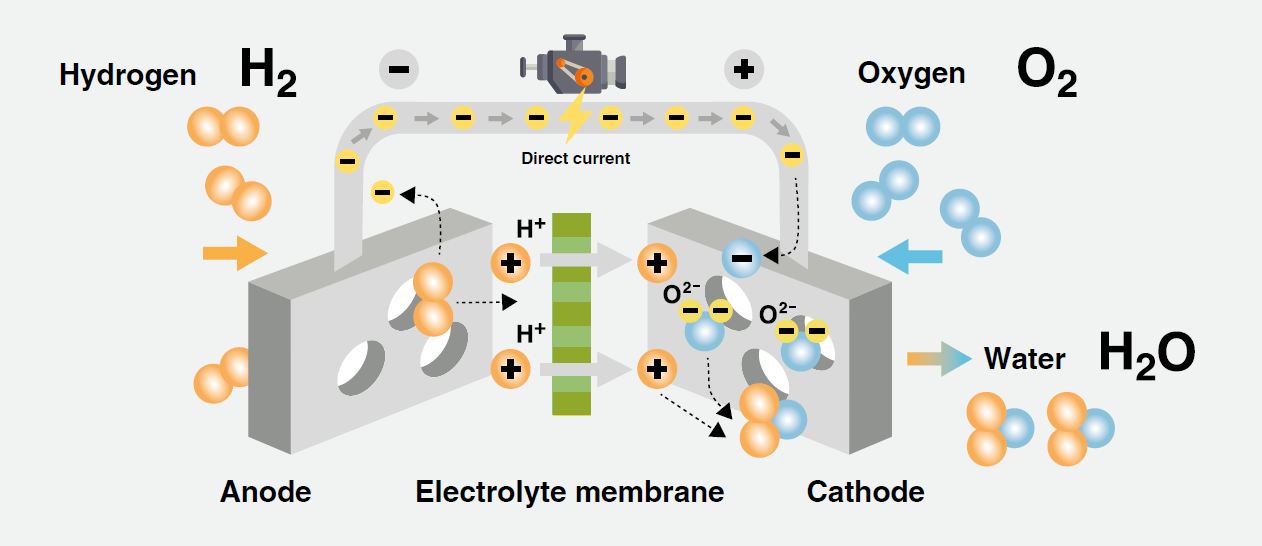
Diagram showing how a hydrogen fuel cell works. For clarification, electrodes and electrolyte Membrane have been visualised separately. In the anode, hydrogen is split by a catalyst into H+ and e–. While the electrons flow towards the cathode via an external energy circuit, the protons go through the electrolyte membrane (polymer or ceramic). In the cathode, protons, electrons and atmospheric oxygen produce water molecules. The end products of the process are pure water, electricity and heat.
To find out about the next opportunity for hydrogen as the fuel of the future, read the fascinating article in carl 04/2026, starting on page 14 [11].
In 2025, the Federal President’s Award for Technology and Innovation was awarded for the Fuel Cell Power Module, a new fuel cell drive that can power heavy goods vehicles up to a thousand kilometres without releasing any emissions. We report on this in the blog article titled Green power for heavy loads: fuel cells in lorries.
Whether biohydrogen from algae or artificial hydrogenase systems will ever actually power our cars remains doubtful – at least for the near future. Nevertheless, it would be wonderful to see these little masters of synthesis continue their early success story.
Sources:
[1] K. Delgado et al., Catalysts 2015, 5, 871–904. DOI: https://doi.org/10.3390/catal5020871
[3] S. A. Grigoriev et al., Int. J. Hydrogen Energy 2020, 45, 26036–26058. DOI: https://doi.org/10.1016/j.ijhydene.2020.03.109
[4] Biowasserstoff aus Algen: Chancen und Herausforderungen | BDEW
[5] H. Wendt, G. H. Bauer, in Hydrogen as an Energy Carrier: Technologies, Systems, Economy, Ed.: C.-J. Winter, J. Nitsch, Springer, Heidelberg 1988.
[6] H. Miyaoka et al., Int. J. Hydrogen Energy 2012, 37, 17709–17714. DOI: https://doi.org/10.1016/j.ijhydene.2012.09.085
[7] M. A. Marwat et al., ACS Appl. Energy Mater. 2021, 4, 12007–12031. DOI: https://doi.org/10.1021/acsaem.1c02548
[8] F. Safari, I. Dincer, Energy Convers. Manage. 2020, 205, 112182. DOI: https://doi.org/10.1016/j.enconman.2019.1121
[9] T. Happe, JD Naber, European Journal of Biochemistry. 1993, 214, 475-481 DOI: 10.1111/j.1432-1033.1993.tb17944.x
[10] Bioökonomie.de. Biowasserstoff: Quellen und Forschungsansätze
[Internet]. Potsdam, Blattmacher Kommunikation und Wissenschaft GmbH 2026 [zitiert am 29. Mai 2026]. https://biooekonomie.de/themen/dossiers/biowasserstoff-quellen-und-forschungsansaetze#dossier-page-1
[11] F. Frick, Die nächste Chance für den Stoff der Zukunft. carl, 2026. Ed.: Carl Roth GmbH + Co. KG, 4, 14 https://blaetterkatalog.carlroth.com/CARL_2604_DE/