

Apoptosis Now
Embracing programmed cell death for new therapeutics
Life is inextricably linked to death. Inevitably, every life ends in death. But, is every death really an end? Not necessarily.
After all, sometimes it is in fact death that makes life possible, or even creates life: evolution has given rise to processes that target and eliminate diseased, infected, defective or superfluous cells – thereby helping to shape and protect the life of the organism. This programmed cell death, as it is known, can be found in virtually all multicellular life forms from plants and fungi through to animals and humans. And it may be that its history stretches back further still: even single-cell organisms show signs of adopting a kind of controlled cellular suicide. This suggests that this process may have originated more than one billion years ago.
One form of programmed cell death is apoptosis, a genetically fixed, highly regulated process.In contrast to what is known as pathological necrosis, which is an altogether more chaotic process that damages cell membranes or ruptures cells und so triggers inflammatory responses, apoptosis leaves nothing to chance. It is always a controlled process: the integrity of the cell membranes remains intact, the cell is fragmented, at the end the cell is dead and its remains are recycled by phagocytic cells.
This does not cause inflammations or any other aggressive side effects, the surrounding tissue remains unaffected by events. Apoptosis is therefore also ideal for bringing order to processes such as embryonic development. The formation of fingers, toes or nostrils is the result of the controlled removal of intermediate cells, as is the maintenance of tissue homeostasis or immunological functions [1,2].
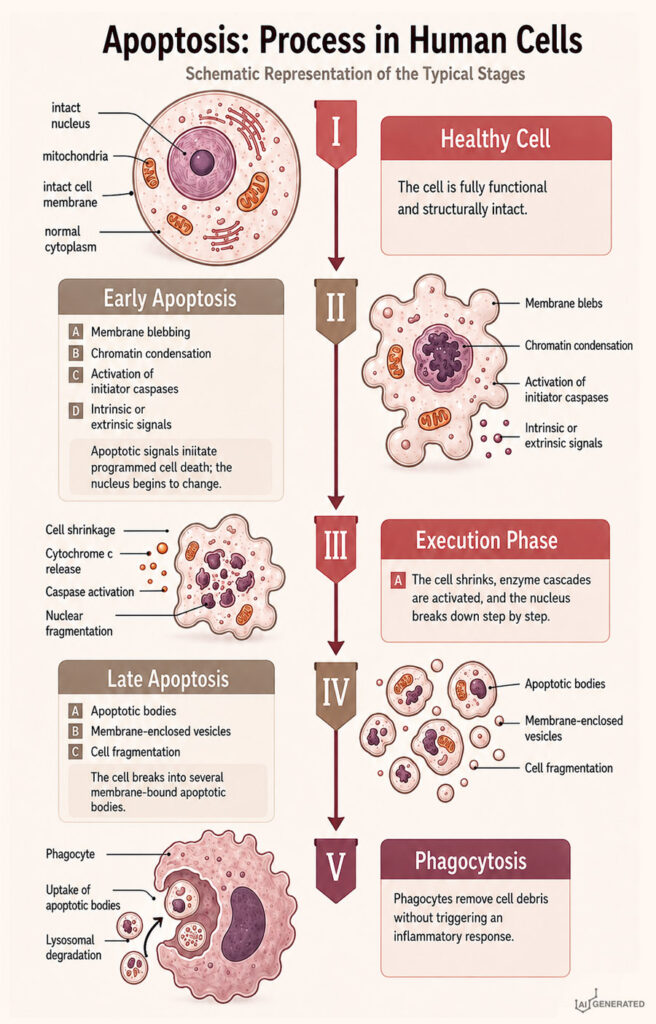
Regulated processes in biology are always the result of interlinking signal cascades. There are in fact several signalling pathways at play in apoptosis, with the intrinsic (mitochondrial) and extrinsic (death receptor) pathways being the most important [2]. The extrinsic death receptor signalling pathway is triggered when natural ligands are bound to specific surface receptors, while the intrinsic mitochondrial apoptosis pathway is triggered by DNA damage and cellular stress. Both signal transduction pathways activate proteases of the caspase family, which cause cell death through proteolytic cleaving of vital cell proteins and constitute a typical feature of apoptotic cell death [3]. In typical physiological conditions, the apoptosis prevents damaged or superfluous cells from accumulating, which in turn preserves tissue integrity [4].
Although, as is well known, wherever there is light, there are also shadows. Often, heavily regulated processes are also susceptible to errors, and that is no less true for apoptosis. For instance, the sensitive balance of the intrinsic pathway involves a complex interplay of pro-apoptotic and anti-apoptotic proteins. The dysregulation of apoptosis is therefore associated with various diseases.
The names of the ligands in question, such as the tumour necrosis factor (TNF) or the p53 tumour suppressor protein, give an indication of which diseases this includes: apoptosis, or specifically its dysregulation, is one of many factors closely associated with the development of cancer. Consequently, this evident connection has been the subject of research since apoptosis was first discovered in the early 1970s. However, autoimmune diseases, neurodegenerative diseases and cardiovascular diseases can also be associated with a dysregulation of apoptosis. A precise understanding of apoptosis signal transduction therefore presents opportunities for therapeutic interventions, namely developing new active substances designed to either purposefully trigger apoptosis or prevent it.
Apoptosis Now – new tactics in the war on cancer
One main mechanism of conventional radiotherapies and chemotherapies to treat cancer is the activation of the mitochondrial (intrinsic) apoptotic pathway [3]. Tumour cells, or generally speaking all fast-proliferating cells, are damaged by radiation or chemotherapy drugs and stress stimuli are released, activating the intrinsic apoptotic cascade and triggering programmed cell death. However, what makes cancer cells so treacherous is their often extreme plasticity, i.e. their ability to adapt. Not only do they often evade the body’s immune defences, but sometimes they also counter the pressure of therapies with extreme flexibility by finding “diversion routes” – or in other words, they develop resistance. In the case of apoptosis, genetic modifications of the tumour cells, over-expression of anti-apoptotic proteins and a downregulation of pro-apoptotic factors can enable tumour cells to withstand apoptosis and become resistant to treatments based on apoptosis [3]. This results in their uncontrolled reproduction, a major characteristic of cancer. It is therefore apparent, and in many cases also highly promising, that this is precisely where focus must be applied by pharmacologically targeting cancer cells to induce apoptosis.
Owing to the comparatively long research history in this field, numerous active substances have already progressed from their infancy in research into clinical application, with new discoveries added each year. For example, Bcl-2/MCL1 inhibitors block the anti-apoptotic proteins Bcl-2 or MCL1, and can thereby guide cancer cells back to the extrinsic (death receptor) pathway [5]. These are already widely used in modern cancer therapies.
In cancer cells, the all-important p53 tumour suppressor is often mutated, disabling its function as an apoptosis regulator. Another strategy for stimulating apoptosis specifically in cancer cells is to convert the mutated p53 back into wild-type p53. This can be achieved, for instance, by means of pharmacologically active “small molecules”, i.e. reagents with a molecular weight of less than 800 g/mol, which are generally able to pass through cell membranes. There are currently various clinical studies under way exploring new active substances that may be capable of achieving this [2]. Other highly promising anti-tumour therapeutics are agonistic antibodies, which bind the apoptosis-inducing (TRAIL) receptor into activation, thereby triggering the TNF-mediated extrinsic apoptosis [8]. For this mechanism too, various new active substances are the focus of current clinical studies [2].
In 2024, a total of 31 active substances that target cancer cells via apoptosis signalling pathways were in clinical or pre-clinical studies [2]. The indications are wide-ranging, spanning from leukaemias and lymphomas and lung cancer to breast, prostate and bowel cancer. The fact that apoptosis-regulating signal cascades are so complex and still not fully understood continues to hamper current therapies, yet at the same time offers many promising starting points for therapeutic interventions that target apoptosis.
It is little wonder, therefore, that research in this area is so very dynamic. For example, last year, researchers at Magdeburg University of Medicine, published their findings on active substance FLIPinB, which targets the apoptosis regulator c-FLIPL and could be used against pancreatic cancer [6,7]. The new active substance activates the caspase-8 enzyme, which triggers apoptosis in cancer cells. In the study, FLIPinB was also combined with two other drugs that are already used in the treatment of pancreatic cancer: chemotherapy drug gemcitabine and the Mcl-1 inhibitor S63845. This combination of active substances boosted the development of a vital protein complex that triggers cell death in tumour cells. In laboratory experiments, the treatment led to a significant reduction in tumour cells, while healthy cells remained largely unaffected [6,7]. This opens up a therapy possibility to combat a type of cancer that is still rarely diagnosed early and that up until now tends to come with a poor prognosis.
In all the darkness caused by the potentially deadly effects of dysregulated apoptosis, these examples clearly demonstrate that it is possible to step back into the light and to use therapeutic intervention to support apoptosis in serving its actual purpose: to protect life.
Programmed cell death is defined as the controlled and gene-regulated death of cells in a multicellular organism. Currently, a distinction is made between various forms of programmed cell death, including the following types:
Apoptosis is often considered the programmed cell death, though it only constitutes one of several types. It can be triggered by external or internal signals, such as targeted molecular “suicide orders” or through the absence of cell-to-cell contacts (death by neglect). This leads to the activation of what are known as caspases, special enzymes that systematically break down the cells. In a controlled process, the cell is broken down into membrane-covered fragments, known as apoptotic bodies; viewed under a microscope, the characteristic process of blebbing can be observed. Parallel to this, the cell nucleus condenses and fragments.
Though the process known as necroptosis exhibits properties of classic necrosis, it is considered a regulated form of necrotic cell death. For example, it can be triggered by tumour necrosis factors such as TNF-α, which bind to membrane death receptors. Unlike apoptosis, this process breaks down the cells without activating the caspase system, though the exact processes are the subject of current research studies [10].
During the development of an organism, the process of recycling cell structures that are not (or no longer) needed can lead to the targeted elimination of the cell; this process is termed autophagic cell death. Should irreparable defects occur during nuclear cell division or mitosis, the affected cells are targeted and deactivated in a controlled manner. This mitotic catastrophe prevents the emergence of cells with defective or incomplete chromosome sets and therefore helps to prevent the development of tumours.
Should certain cell types lose contact with the extracellular matrix and therefore miss the survival signals it transmits, then – similarly to the apoptotic death by neglect – the Anoikis programme (from the Greek word for “homelessness”) is started.
In tumours in particular, a process called entosis is observed. This involves a tumour cell being engulfed and digested by another tumour cell of the same type, with the administered apoptosis inhibitors powerless to stop the process.
Parthanatos is a regulated form of cell death mediated by an apoptosis-inducing factor (AIF). Research into this is still in the early stages, but this is extremely relevant, since parthanatos plays a part in strokes, diabetes, inflammations and neurodegenerative conditions, among others.
One possible subtype of apoptosis is pyroptosis, a caspase-1-mediated programme, through which the cells can exhibit both apoptotic and necrotic breakdown. Pyroptosis was first described in bacterially infected macrophages, though it seems not to be limited to these types of cell.
An iron-dependent form of cell death was first recorded in 2012 [10]. A characteristic of what has been termed ferroptosis is the iron-dependent accumulation of reactive oxygen species (ROS), especially in the form of membrane lipids damaged by oxidation, which ultimately leads to cell death.
Contact with specific chemicals or pathogens can trigger what is termed NETose in neutrophil granulocytes. This sees components of the cell nucleus and the cytoplasm released as neutrophil extracellular traps (NETs). Although generally deadly for the cells in vitro, most granulocytes survive this process in vivo by means of as yet unknown mechanisms.
A common process, although one rarely considered in relation to programmed cell death, is cornification. This is essential for the formation of external skin layers, as well as hairs, feathers, scales or horns. Today, it is no longer understood purely as a final differentiation, but as a standalone cellular death programme.
Sources:
[1] H. Hug, 2000. Apoptose: die Selbstvernichtung der Zelle als Überlebensschutz, Biologie in unserer Zeit, 128-135.
[2] M. Mustafa et al., 2024. Apoptosis: A Comprehensive Overview of Signaling Pathways, Morphological Changes, and Physiological Significance and Therapeutic Implications. Cell, 13, 1838. doi: 10.3390/cells13221838
[3] AG Wesselborg: Signaltransduktion der Apoptose ǀ UKD
[4] S. Mantri und G.M. Doshi, 2025. Reactivating apoptotic pathways in cancer: A review of novel therapeutic approaches. Eur. J. Pharmacol., 1003, 177965, doi: 10.1016/j.ejphar.2025.177965
[6] Neuer Therapieansatz gegen Bauchspeicheldrüsenkrebs
[7] C. König et al., 2025. Pharmacological targeting of caspase-8/c-FLIPL heterodimer enhances complex II assembly and elimination of pancreatic cancer cells | Communications Biology
[8] X. Piao et al., 2016. TRAIL-receptor 1 IgM antibodies strongly induce apoptosis in human cancer cells in vitro and in vivo. OncoImmunology 5, doi.org/10.1080/2162402X.2015.1131380
[9] L. Galluzzi et al., 2018. Molecular mechanisms of cell death: recommendations of the Nomenclature Committee on Cell Death, Cell Death and Differentiation, 25, 486–541, doi:10.1038/s41418-017-0012-4
[10] J.D. Scott et al., 2012. Ferroptosis: An Iron-Dependent Form of Nonapoptotic Cell Death. Cell, 149, 1060–1072, doi:10.1016/j.cell.2012.03.042
What is apoptosis?
Apoptosis is a form of programmed cell death: the cell self-destructs following a strictly controlled genetic programme, without harming any surrounding tissue or triggering any inflammation.
Why is apoptosis important for the body?
Apoptosis removes superficial, infected or damaged cells. Among other things, it supports embryonic development, tissue homeostasis and the function of the immune system.
What is the difference between apoptosis and necrosis?
With apoptosis, the cell membrane initially remains intact, the cell disintegrates into fragments in a controlled manner and is recycled. Necrosis, by contrast, is a largely uncontrolled process, which can destroy cell membranes and trigger inflammation responses.
Which signalling pathways trigger apoptosis?
Among the most important apoptosis signalling pathways are the intrinsic mitochondrial pathway and the extrinsic death receptor pathway. Both can activate caspases, which split central cell proteins and trigger cell death.
Why are cancer cells able to evade apoptosis?
Cancer cells are able to avoid apoptotic signals, for instance by mutating or through the overexpression of anti-apoptotic proteins or through reduced activity of pro-apoptotic factors. This enables them to survive and carry on reproducing.
How does cancer treatment make use of apoptosis?
Many conventional radiotherapies and chemotherapies activate the intrinsic apoptosis pathway by damaging tumour cells and triggering cellular stress. New therapy approaches are also endeavouring to target the reactivation of blocked apoptosis signalling pathways.
Which active substance strategies are targeting apoptosis in cancer cells?
Bcl-2 and MCL1 inhibitors, p53-reactive small molecules and agonistic antibodies against TRAIL receptors are some of the substances currently being researched and used. The aim is to resensitise cancer cells to programmed cell death.
Is apoptosis the same as programmed cell death?
Apoptosis is often compared to programmed cell death, however it is only one of several forms of programmed cell death. Other regulated cell death programmes include necroptosis, autophagic cell death, pyroptosis and ferroptosis.