



CO₂ vacuum cleaner for the atmosphere
How realistic are DAC technologies for mitigating climate change?
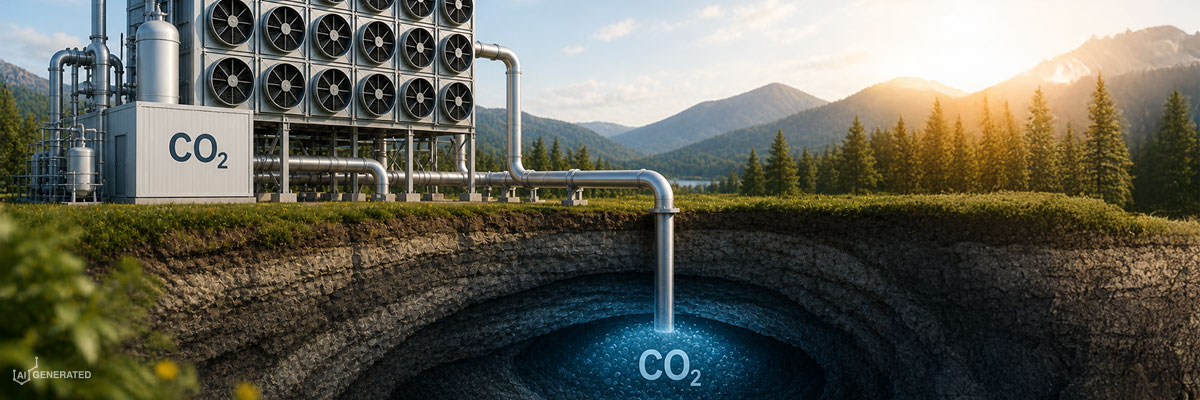
Large fans draw in air, sorbents absorb CO₂ – and at the end of it all, the greenhouse gas disappears into the subsoil for millennia. Direct air capture may sound like science fiction, but it has long since been a reality. The first plants in Iceland demonstrate what is technically feasible. But is it enough to achieve climate targets?
Climate targets are starting to falter – and there are no simple solutions. While global emissions continue to rise, one idea is increasingly in the spotlight: collecting CO₂ straight out of the air.
Climate change affects us all, yet few of us are prepared to restrict ourselves and go without our usual comforts to protect the climate. This is all too understandable; ultimately, the effects are often only felt huge distances away from our own actions. So, few are surprised that the ambitious climate targets set by the global community in the form of the Paris Climate Agreement appear increasingly unachievable.
At the World Climate Conference (COP 21) in 2015, the 1.5-degree target was set; i.e. an agreement to sufficiently curb global warming in this century such that it remains within 1.5 °C of pre-industrial levels.
The reality has long since looked quite different: in 2024, for the first time, the global temperature was above the 1.5 degree threshold for the entire year [1].
Yet all hope is not lost. However, for the best-case scenario of maximum 1.5 °C global warming, emission cuts alone are no longer enough. “Pathways that aim for limiting warming to 1.5°C by 2100 after a temporary temperature overshoot rely on large-scale deployment of carbon dioxide removal measures,” stated the 2018 IPCC Report by the international climate mitigation organisation Intergovernmental Panel on Climate Change [2].
It is barely possible to achieve the 1.5-degree target without actively removing CO₂. As an emergency plan against global warming, there are therefore technical methods that actively remove CO₂ from the air; these methods are termed carbon dioxide removal, or CDR for short.
Vacuum cleaners for greenhouse gases
At first, it sounds like a future utopia. But many CDR approaches are in fact nothing new, and have in fact been in use for decades. Conventional methods include forestry practices such as reforestation, restoring wetlands or changing land use, which encourages carbon storage in the ground.
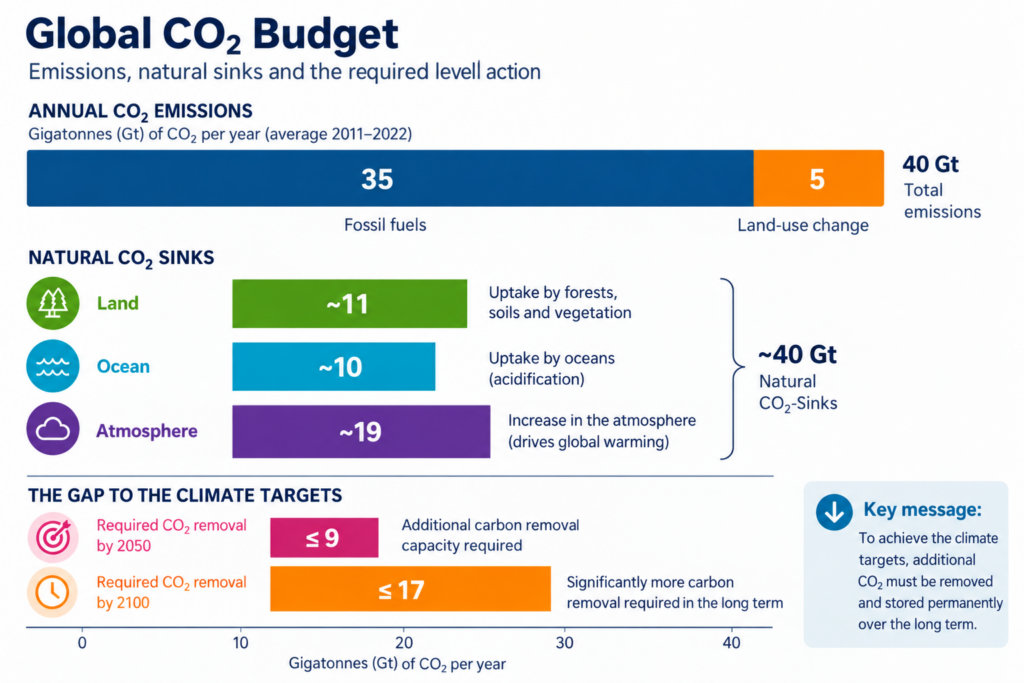
So far, so inadequate. Current conventional methods are not enough to offset the CO₂ surplus. Because these established methods alone will not stave off the excess of CO₂ [3]. The State of Carbon Dioxide Removal report estimates that between now and 2050, some seven to nine Gt CO₂ will have to be removed each year in order to hit the climate targets of the Paris Agreement. At present, conventional methods are only delivering a removal rate of roughly two Gt CO₂ per year [3].
This is where the new technical CDR methods come into play. According to the report, these currently account for only 0.0013 Gt CO₂ removal per year – i.e. an imperceptibly small proportion – though this figure could rise quickly and come to represent a key contributor [3]. When it comes to technical carbon dioxide removal, direct air capture (DAC) methods are particularly widespread. Large units draw in air and filter out CO₂ from the atmosphere using sorption-based materials. These may be solid systems, such as porous zeolites or organometallic frameworks, or fluid systems that selectively absorb the CO₂ in a solution, for example in ethanolamine or hydroxide solutions.
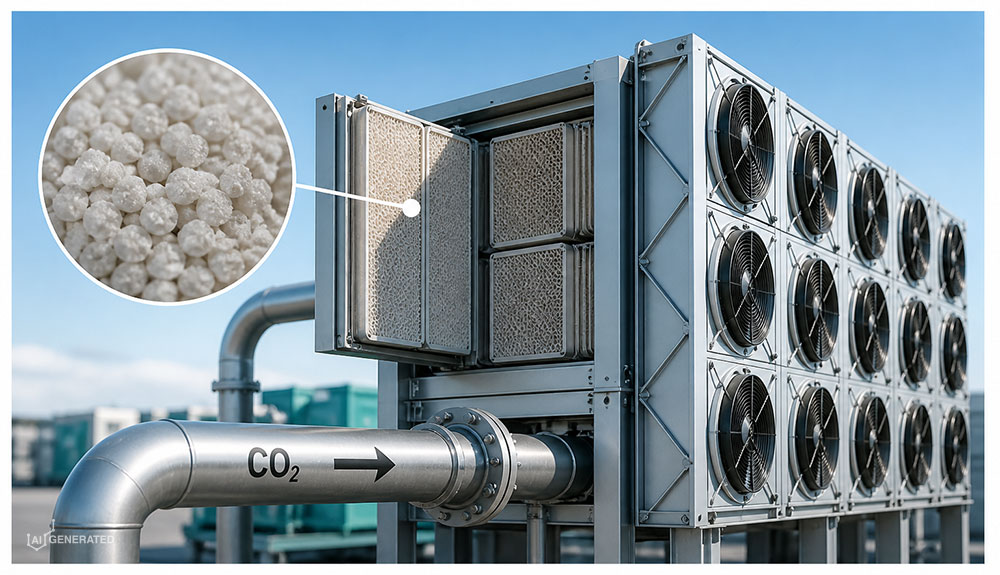
The separation media is then regenerated, for instance by means of heat, releasing the CO₂. Then, the enriched gas can be collected, compressed and transported onwards – either for industrial use as an industrial gas or basic chemical or for permanent storage [4]. The latter is known as direct air capture with carbon storage, or DACCS for short. This involves pumping the separated CO₂ into geological formations and storing it there, for instance in deep saline aquifers or basalt rock. Owing to mineralisation, it remains there for thousands of years, permanently absorbed [4]. Most critically: this permanently locks away the CO₂. Most critically: this permanently locks away the CO₂.
An overview of other carbon removal technologies
BECCS (bioenergy with carbon capture and storage):
Biomass is used to generate energy, the resultant CO₂ is separated and geologically stored. Major potential (up to 328 Gt CO₂ by 2100), though space and water requirements are high.
Biochar:
Biomass is charred in an environment without oxygen and stored in the ground. Relatively inexpensive (70–170 euros per tonne of CO₂) and has a positive impact on soil quality – though scalability is limited.
Enhanced weathering:
Finely ground stone absorbs CO₂ through natural weathering processes. Very long-term storage, but high material and logistics requirements.
Ocean alkalinity enhancement:
Alkaline substances increase the CO₂ absorption of the seas and could simultaneously counteract acidification. However, there is not enough research into the ecological impacts of this method as yet.
Negative emissions for climate change mitigation
There are already some examples of modern DAC technology in action. For instance, a company called Climeworks, based in Hellisheiði geothermal power station park in Iceland, operates two plants named Orca and Mammoth, capable of removing up to 4000 tonnes CO₂ per year (Orca) and up to 36,000 tonnes CO₂ per year (Mammoth). By way of comparison, an average 500-megawatt coal-fired power station emits approximately 11,000 tonnes of CO₂ per day [5]. It would therefore take more than 100 DAC plants the size of Mammoth to offset a single coal-fired power station.
Climeworks plants use a solid sorbent. This absorbs and concentrates the CO₂, which is then desorbed at 100 °C before finally being permanently stored in basalt rock by means of natural mineralisation.
Other large-scale plants are under construction in the USA, for example. In Texas, a company named 1PointFive is building the largest plant to date, named “Stratos”, capable of removing up to 500,000 tonnes CO₂ per year; in Louisiana, the US Department of Energy is joining forces with partners Battelle, Climeworks and Heirloom in planning for an annual capacity of approximately one million tonnes by 2030 [4].
Appealing in theory, complicated and expensive in practice
So, is everything going in the right direction for the 1.5-degree target? Sadly, it’s just not that simple. Although the technology exists and is already in operation, it remains a less-than-perfect solution in the race to limit carbon emissions.
This is because the cost of DAC is currently still substantial. At present, Climeworks’ operations cost more than 860 euros per tonne of CO₂, while other providers, such as Carbon Engineering, state their costs as around 515 euros per tonne of CO₂ [5, 6]. Prognoses do at least suggest economies of scale and technological advances could potentially reduce costs to between 200 and 465 euros per tonne of CO₂ by 2050 [6]. Though that is still infinitely more than the current CO₂ price in European emission trading of around 70 euros per tonne CO₂-equivalent – of course, that value may well change over the coming decades (with the necessary political measures) [7]. DAC is technically feasible, but currently still energy-intensive and expensive.
But back to carbon capture technology. At present, the most logical site of application for this is in the industrial parks themselves – at the mouth of the chimney so to speak, where CO₂ concentrations are especially high. Exhaust gases with CO₂ concentrations of eight to 14 percent are simply far more suitable for the adsorption process than the minimal CO₂ content of just 0.04 percent found in average ambient air.
To achieve efficient removal rates at such low concentrations, huge quantities of air have to be fed through the sorbent – which means a high energy requirement for the ventilation systems. For instance, capturing carbon from ambient air consumes 1.8 to 3.6 times more energy than when applying the same process to industrial exhaust gas, according to the estimates of one expert cited in a Springer Professional article [5].
Forecasts indicate that preventing emissions in the first place is still vital
The actual scale of the challenge becomes clear when you look at the capacities: one overview projected annual global CO₂ removal of around 567,000 tonnes CO₂ at the hands of 84 DAC plants by the end of 2025 [8]. However, these statistics included the new Stratos mega-plant, which on its own should account for 500,000 tonnes CO₂ to that figure, despite the fact it is still not in operation. And even if all the planned projects were delivered, their total capacity would only amount to an estimated 5.4 million tonnes CO₂ per year by 2032, from approximately 114 plants [8]. So, still a long way from the negative emissions of five to seven billion tonnes CO₂ per year required by 2050. Even with all the currently planned DAC plants working together, they would only achieve a fraction of the negative emissions required.
Another hurdle is the energy demand of the plants. Obviously, this demand would have to be covered by renewable energies only, to ensure that the net total of emissions generated does not exceed the amount of gas removed from the air. And the demand is vast. This is illustrated by a modelling in which scientists assume “business as usual” (delayed mitigation scenario), where humanity cuts the global emissions too slowly and instead commits to extensive use of DAC in the second half of the century. In this scenario, experts estimate that DAC technologies could devour up to one quarter of the world’s energy production by the year 2100 – approximately 300 exajoules [9]. This quantity equates to the global supply of coal and natural gas in 2018 [5]. In the long term, DAC technologies could demand enormous quantities of renewable energy.
Conclusion
Direct air capture is no silver bullet. As such, the mechanical removal of CO₂ remains at best a supporting technology to offset the delay of emission reductions to some extent. This is also the view of environmental engineer Dr. Kimberly A. Gray from Northwestern University in the USA. In the chapter that she authored in the book Climate Geoengineering: Science, Law and Governance, she reached the following conclusion: “With the current state of technology and under the current economic conditions, however, none of the methods could be used to remove CO₂ from the air – either alone or in combination – to achieve the target of limiting warming to two degrees, without enduring unsustainable biophysical or economic impacts.” [5]
Over the long term, however, direct air capture could still play an important part in a wide portfolio of climate change mitigation measures – provided that the technology is operated far more efficiently, economically and is run on exclusively renewable energy. To put it in perspective, DAC can be considered one building block in the fight against climate change – but it is no substitute for outright emission cuts. However, even with negative emissions being achieved through DAC and other technologies, it remains a race against time – and a battle for every single tonne of greenhouse gas that is prevented from entering the atmosphere in the first place or is removed from it. After all, the most effective tonne of CO₂ is the one that never exists in the first place.
Sources:
[1] Umweltbundesamt (2024): Das 1,5-Grad-Ziel nach dem Übereinkommen von Paris. Was passiert, wenn wir 1,5 Grad überschreiten? Gibt es danach noch einen Weg zurück? Online verfügbar unter: https://www.umweltbundesamt.de/
[2] IPCC (2018): Special Report on Global Warming of 1.5°C. Intergovernmental Panel on Climate Change. Online verfügbar unter: https://www.ipcc.ch/sr15/
[3] NOAA (2024): Carbon Dioxide Removal: A NOAA State of Science Factsheet. National Oceanic and Atmospheric Administration. Online verfügbar unter: https://www.climate.gov/
[4] Senken.io (2024): Direct Air Capture – Technologie und Funktionsweise. Academy. Online verfügbar unter: https://www.senken.io/de/academy/direct-air-capture
[5] Springer Professional (2023): Diese Technologien filtern CO₂ aus der Luft. Online verfügbar unter: https://www.springerprofessional.de/
[6] Springer Professional (2023): CO₂-Filterung aus Luft teurer als bisher angenommen. Online verfügbar unter: https://www.springerprofessional.de/
[7] UBA (2025): Der Europäische Emissionshandel. Online verfügbar unter: https://www.umweltbundesamt.de/
[8] Allied Offsets (2025): The Current State of Direct Air Capture. Online verfügbar unter: https://blog.alliedoffsets.com/the-current-state-of-direct-air-capture
[9] Realmonte, G. et al. (2019): An inter-model assessment of the role of direct air capture in deep mitigation pathways. Nature Communications 10, 3277. DOI: 10.1038/s41467-019-10842-5.