

Bombardier beetle vs. attacker
Feel the heat!
The bombardier beetle (in the Brachininae subfamily) is one of the smallest yet most impressive masters of defence in the animal kingdom. With a body measuring only 5–7 mm in length, it has a defence strategy like no other: a controlled chemical “explosion” from its abdomen. Despite its small stature, the beetle can effectively repel a whole host of predators, including ants, spiders, frogs and small reptiles. This combination of precision, chemistry and mechanics makes the bombardier beetle a fascinating object of study for biology, chemistry and material research.
When insects defend themselves
In nature, survival is often a question of efficient defence. While many insects opt for camouflage or escape tactics, the bombardier beetle has perfected an active, chemical defence. Rather than passively lying in wait, it reacts to threats with a targeted counterattack. Central to its defence is a highly complex system of glands in its abdomen, which functions almost like a biological high-performance reactor. Within milliseconds, this strategy transforms a potential predator into a fleeing victim – making the beetle an impressive example of how animals can ingeniously adapt over the course of evolution.
The controlled “explosion”
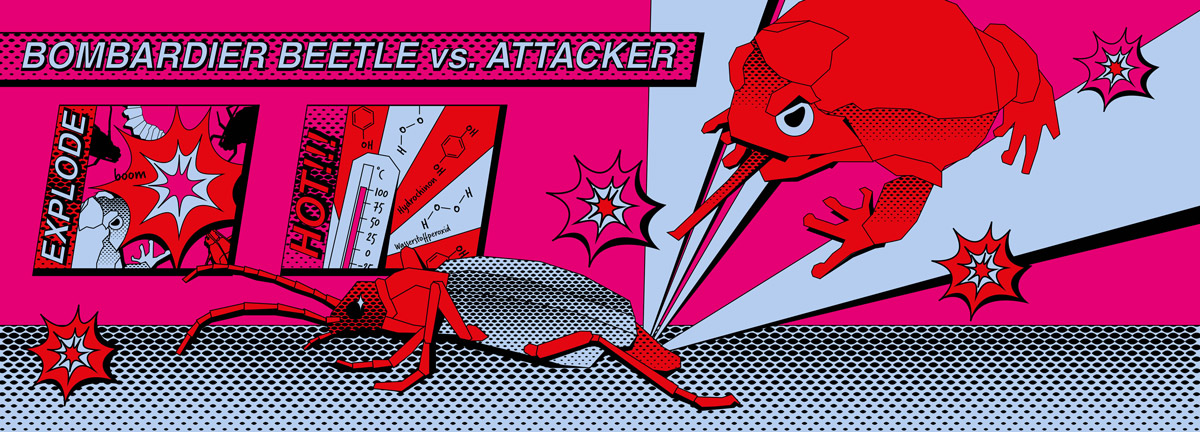
Inside the bombardier beetle’s abdomen are two distinct systems of glands. These store the chemicals hydroquinone and hydrogen peroxide – substances that by themselves are relatively harmless. If, however, the beetle perceives a threat, both substances are released into a special reaction chamber. There, they come into contact with enzymes that act as biological catalysts, triggering an extremely fast chemical reaction.
The result is truly explosive, with the release of oxygen rapidly heating the mixture to almost 100 °C. The resultant hot and pungent-smelling liquid is expelled from the abdomen in short, sharp bursts – aimed directly at the attacker. This effectively deters or even injures ants, spiders, frogs or small reptiles – in some cases even fatally.
The science behind the shots
Particularly notable is the way the chemical explosion is skilfully controlled. The bombardier beetle’s abdomen features moving segments, which act like a flexible nozzle. This allows the beetle to steer the jet in almost any direction with extreme precision, without having to twist its body. The pulsing discharge of liquid is no accident: it stops the heat generation from causing harm to the tissue of the beetle itself. The brief pauses in firing keeps the pressure in the chamber under control, since the reaction chamber cools down briefly. In simplified terms, the beetle “shoots” in small doses so that it doesn’t overheat.
This ability to precisely control the chemical processes on a tiny scale today serves as a model for developing cutting-edge micro-reactors and dispensing systems.
Ecological significance and evolutionary adaptation
Its effective defence has enabled the bombardier beetle to find its niche within the ecosystem. Its defence is so effective that even frogs that have swallowed the beetle will often spit the beetle back out completely unharmed after an explosion is triggered in the frog’s stomach. This “getaway tactic” guarantees the beetle’s survival, even in seemingly desperate situations.
In scientific terms, the bombardier beetle is proof that defensive strategies and ecological success go hand in hand. The defence mechanisms protect the population from being decimated by generalists, enabling the beetle to exist in a wide range of habitats around the world.
The bombardier beetle is of inestimable value as a model system for biologically inspired technology (bionics). Central to the research is micro-reaction technology – i.e. the development of especially small and controllable reaction systems – as well material science, which explores how the wall of the reaction chamber withstands extreme heat and pressure loads. One other important aspect is safety management, whereby the principle of spatial separation of reactive components (two-component system) is applied to the chemical industry and in special adhesives.
Whether you need fast chemical reactions, catalysts or the safe handling of reactive substances: Carl ROTH is by your side with an extensive range of suitable chemicals and laboratory equipment for precision experiments. Discover our online shop at www.carlroth.com
Sources:
https://www.spektrum.de/lexikon/biologie/bombardierkaefer/9985
https://www.spektrum.de/news/das-explosive-geheimnis-der-bombardierkaefer/1344470
https://www.planet-wissen.de/technik/erfindungen/sprengstoff/pwie-bombardierkaefer-100.html