



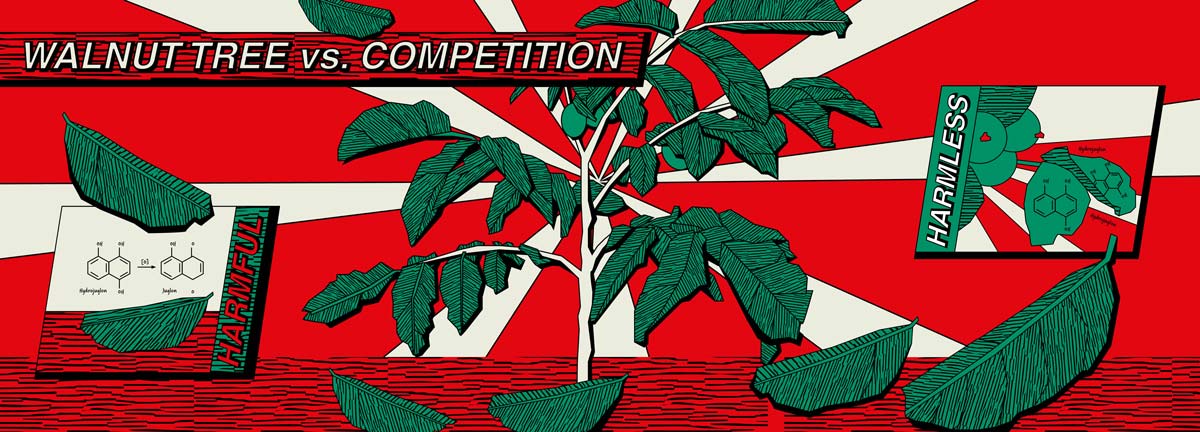
Walnut Tree vs. Competitors
Plants are in constant competition for light, water and nutrients. Yet they do not rely solely on height, leaf area or efficient metabolism to gain an advantage. Many species also shape their immediate environment by releasing chemical compounds that trigger biochemical processes in the soil and can, for instance, influence the growth of neighbouring plants.
This phenomenon is known as allelopathy: the release of biologically active substances by plants into their surroundings, where they may affect the germination, growth or metabolism of other species. In scientific terms, allelopathy is not inherently harmful; depending on the substance, concentration and environmental conditions, its effects may be beneficial, inhibitory or neutral.
The common walnut (Juglans regia) is among the best-studied examples of this strategy. Its chemistry illustrates how subtle processes below ground can help determine which plants thrive in a community – and which struggle to gain a foothold.
Chemical exchanges in the root zone
Allelopathically active substances reach the environment through several routes. They can be secreted by roots or released as leaves, fruits and other plant material break down. Once in the soil, they are modified by chemical reactions and microorganisms – and it is often only then that their biological effects become apparent.
In walnut trees, the key precursor is hydrojuglone, a natural compound found in the leaves, roots and green fruit husks. As these plant parts enter the soil, oxygen and soil microorganisms gradually convert hydrojuglone into juglone through oxidation. It is this transformed compound that exerts the inhibitory allelopathic effect, altering conditions around the tree to the disadvantage of many neighbouring plants.
When seedlings lose momentum
Juglone does not act like a simple contact poison. Instead, it interferes with essential metabolic processes. Research indicates that it can impair cellular respiration and a range of enzyme reactions, reducing the energy available for growth and development. For plants trying to establish themselves beneath or near a walnut tree, that loss of momentum can be decisive.
Many species are especially vulnerable during germination and early development. Roots elongate more slowly, seedlings emerge later or fail to become established at all. In this way, juglone helps keep the area around the common walnut relatively open – reducing competition for water and nutrients and limiting the chance that neighbouring plants will grow high enough to shade the tree.
A clearer view of natural processes
The chemical interactions between plants and their environment have long been a focus of scientific investigation. Researchers are exploring how allelopathically active natural substances are produced, how they change in the soil and when they become biologically effective. The focus is not only on individual compounds such as juglone, but on the wider interplay between plants, microorganisms and environmental conditions.
The chemical interactions between plants and their environment have long been a focus of scientific investigation. Researchers are exploring how allelopathically active natural substances are produced, how they change in the soil and when they become biologically effective. The focus is not only on individual compounds such as juglone, but on the wider interplay between plants, microorganisms and environmental conditions.
Supporting science. Improving lives.
From analysing natural plant substances to exploring complex soil interactions, modern plant research depends on precision, quality and results you can rely on. As a trusted partner to science, Carl ROTH provides high-quality chemicals, laboratory supplies, consumables and dependable solutions for analytics and research.
Whether you need reagents, sample preparation products, microscopy essentials or protective equipment, the comprehensive portfolio supports efficient everyday laboratory work. Expert technical advice helps researchers select the right products and solutions, so projects can move forward smoothly, reliably and with confidence.
Discover the right products and solutions for your laboratory today at
Find the right products and solutions for your laboratory at www.carlroth.com.
Sources:
https://www.uni-goettingen.de/de/76560.html
https://virtuelle-gaerten.uni-hohenheim.de/4DACTION/W_Init/FeldbotanikSWD_Taxon_de?TaxonID=1105608
https://www.mein-schoener-garten.de/pflanzen/walnuss/walnussbaum
https://www.spektrum.de/lexikon/biologie/allelopathie/2182
https://botanik-bochum.de/jahrbuch/Pflanzenportraet_Juglans_regia.pdf