

Seals vs decompression sickness
When depth poses no threat.
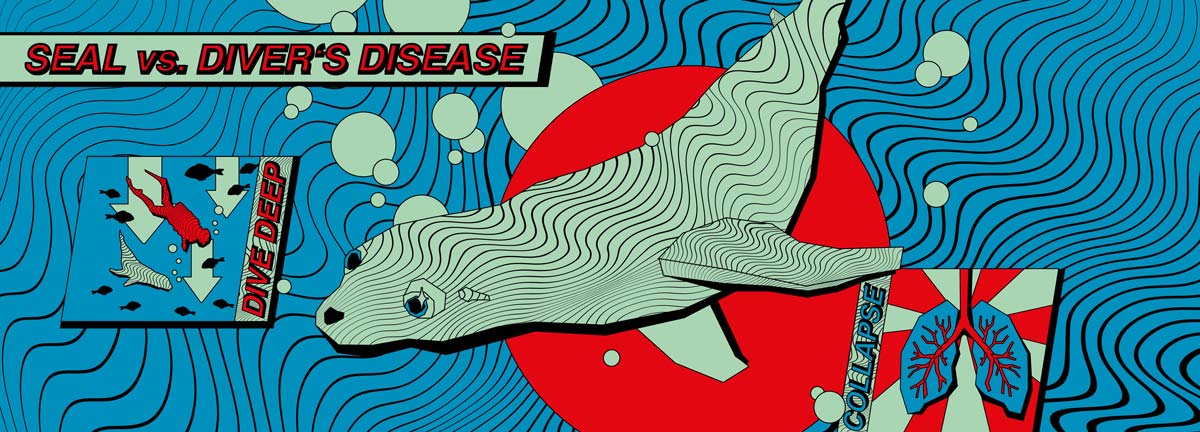
With every metre below the water’s surface, ambient pressure rises. During descent, the change may be barely noticeable. On the way back up, however, it can become life-threatening for humans. If a diver ascends too quickly, gas bubbles may form in the blood and tissues — the cause of what is known as decompression sickness.
Aquatic mammals such as seals, sea lions and whales appear to face no such problem. They dive hundreds, sometimes even thousands, of metres deep, remain submerged for long periods and then return effortlessly to the surface. No decompression stops. No apparent ill effects.
How do they do it?
The answer lies in an extraordinary adaptation of their bodies. Over millions of years, marine mammals have developed mechanisms that shield them from the effects of immense water pressure. One of these mechanisms is so effective that it continues to fascinate researchers in diving physiology, medicine and biology. It is a striking example of how nature evolves solutions that modern science is only beginning to fully understand.
The invisible danger
During a dive, the human body constantly responds to increasing ambient pressure. As the pressure rises, more nitrogen from the inhaled air dissolves in the blood and body tissues. At depth, this is not dangerous in itself.
The critical moment comes during ascent. If ambient pressure drops too quickly, the nitrogen dissolved in the body cannot be exhaled through the lungs fast enough. Instead, tiny gas bubbles form in the blood and tissues. Depending on where they occur, they may block blood vessels, damage nerves or impair organ function. This condition is known as decompression sickness.
For this reason, slow ascents and decompression stops are among the most important safety measures in diving. They give the body enough time to release dissolved nitrogen in a controlled manner.
This is precisely where marine mammals differ. Seals, sea lions and whales routinely dive to great depths and resurface without decompression stops. Yet they appear to be protected from decompression sickness. So what is happening inside their bodies?
The secret of marine mammals
Marine mammals are, of course, subject to the same physical laws as humans. In their bodies, increasing pressure also causes nitrogen from the air held in the lungs to dissolve in the blood. The crucial difference lies in their adapted anatomy and physiology. Marine mammals have exceptionally flexible rib cages. As they dive deeper and water pressure rises, their lungs are compressed more and more. Beyond a certain depth, the alveoli partially collapse, and gas exchange between the lungs and the blood nearly stops. This is precisely what protects the animals.
Because only a small amount of nitrogen from the remaining air in the lungs passes into the blood, only a limited quantity can accumulate in the body. Efficient oxygen stores in the muscles and blood, together with a slower heart rate during diving, reinforce this effect and allow the animals to cope safely even with extreme depths. When they later return to the surface, the risk of dangerous gas bubble formation is therefore extremely low.
What researchers can learn from seals
Seals are among nature’s most remarkable diving specialists. Their ability to reach great depths and return safely to the surface has made them an important focus of research for decades. Understanding how their bodies cope with high pressure and limited oxygen also sheds light on fundamental physiological processes.
Research focuses, among other things, on reduced gas exchange in the lungs, the oxygen supply to muscles and organs, and the adaptation of the cardiovascular system during prolonged dives. Modern analytical methods now make it possible to investigate these complex mechanisms down to the molecular level and to understand their significance for diving physiology more clearly.
These findings provide valuable impetus for medical and biological research. At the same time, they powerfully demonstrate that nature often holds solutions whose full significance can only be revealed through scientific investigation.
Supporting science. Improving lives.
Every natural phenomenon has a story waiting to be explored. Observation sparks hypotheses, analysis creates knowledge, and research drives innovation. Carl ROTH supports scientists throughout this journey — with high-quality chemicals, a broad portfolio for laboratory work and analytics, and expert advice tailored to the practical demands of modern research and routine laboratory practice.
Find out more at www.carlroth.com.
Sources:
https://www.spektrum.de/news/lungenkollaps-rettet-robben-vor-taucherkrankheit/1165262
https://www.gtuem.org/tauchmedizin/sh-15.html
https://flexikon.doccheck.com/de/Taucherkrankheit
https://natur.de/artikel/warum-seeloewen-keine-taucherkrankheit-bekommen