


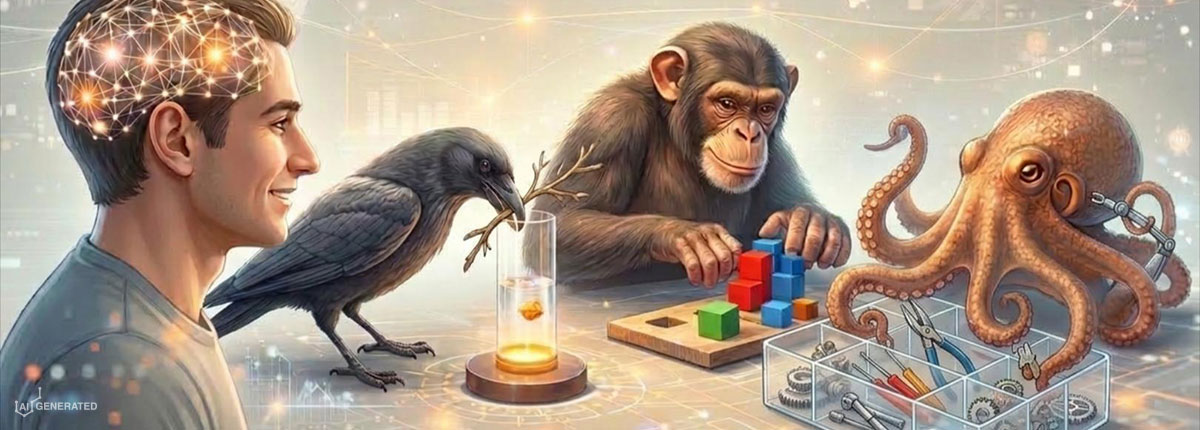
The evolution of cognition – how unique actually is our thought process?
The evolution of cognition is a vast field of research, which still leaves many questions unanswered to this day. But how can we actually investigate our own world of thought? What distinguishes cognition, what does it empower us to do, and what does it allow other animals to do? And are our brains actually the most developed in this regard?
Human beings are regarded as the most intelligent lifeform on Earth. At least, that’s what human beings think. But is this assumption founded or even proven? What sets this intelligence apart? Above all, our power of cognition: we can apply mental processes and structures to take on information, process it and store it. This gives us diverse cognitive ability, such as perception, awareness, memory, language, thought, problem-solving, planning, self-recognition, reflection or intelligence in the sense of an individual quotient. This means we can not only perceive, consider and process everything around us, but we can also select, interpret, analyse or fantasise. We can react to what we have perceived and adapt our actions to our environment and the varied contexts and situations; we can make decisions and cooperate with one another. Based loosely on Descartes’ principle of “I think, therefore I am,” these abilities make us humans what we are.
But we aren’t the only ones. Anyone who shares their home with an animal know that they too can sometimes exhibit remarkable cognitive prowess. As with all structures, processes and characteristics in life, cognition is again the result of an evolutionary development. But does this enable us as humans to automatically place ourselves at the top of the pecking order, simply because we speak and we form complex societies and cultural systems? How do you even begin to research cognition? And have we fully understood its evolution yet?
Interdisciplinarity as the measure of all things
Caroline Schuppli from the Max Planck Institute of Animal Behaviour doesn’t think so. On the institute’s website, she writes: “The evolution of high-level cognition remains one of the biggest unsolved questions in evolutionary biology,” and this is one of the key drivers behind her research. One possible reason – and at the same time the methodological challenge – for this research: cognitive processes do not fossilise. Though we can compare size and shape of skulls against one another, that alone does not allow us to draw any clear-cut conclusions about our world of thought. And yet if we want to understand the evolution of our own cognition, we inevitably have to look to other forms of life – such as other primates, or even birds (especially corvids and parrots), dolphins or octopods. And we have to consider them from as many perspectives as possible. After all, cognitive research is a prime example of interdisciplinarity. It unites different disciplines, such as classic comparative behavioural science, anthropology, archaeology, neurosciences, psychology, molecular biology, as well as IT and computer sciences.
One key method is the comparative approach: the cognitive abilities of different species are systematically compared to identify evolutionary continuities and fractures. This is often achieved by means of behavioural studies. The neuroscientific comparison of brain structures, neuronal networks and development processes allows for conclusions to be drawn in turn, for example on functional specialisations. Modern imaging techniques, gene expression profiling and single-cell sequencing provide increasingly detailed insights in this regard. Developmental psychology studies can shine a light on development-related and contextual influences, among other things. Archaeological and paleoanthropological data such as tool finds, cave paintings, burial practices or references to symbolic actions allow indirect conclusions to be drawn regarding the evolution of cognitive skills. Genetic analyses – such as the comparison of the human genome with that of Neanderthals or great apes – also offer insight into evolution-relevant changes, such as in genes, which influence the neuronal development and formation of synapses. In more recent times, computer-aided models and artificial intelligence have become increasingly significant to this line of research. For instance, simulations of evolutionary processes can demonstrate how cooperation, communication and the ability to learn are evolving. Such models do not replace biological research, but they do help to refine theoretical assumptions.
High-level cognition – a spotlight on research
For many years, two major assumptions dominated the research into high-level cognition and the evolution of the brain:
- The bigger the brain, the more intelligent the species
- The more prominent the neocortex, the more intelligent the species
Both assumptions have turned out to be incomplete and only true in certain circumstances. It seems that the intelligence and cognitive function of a species is not directly proportionate to the sheer size or mass of a brain. In fact, additional criteria such as the density of the brain cells are decisive factors. For instance, although the ostrich has the largest brain of all bird species, the giant bird is by no means the brightest bulb in the box. Crows, by comparison, have more than twice as many neurons in their much smaller pallium (a functional equivalent to the neocortex in mammalian brains). They are capable of astounding cognitive function and are even proven to match primates in terms of physical and social skills, as well as some aspects of cognitive capability.
Another interesting fact highlighted by behavioural scientist Schuppli on her working group’s website: “in large brained species, offspring are often less competent at birth, and must learn how to become fully functioning. This introduces a unique evolutionary problem: larger brained species – who are often more cognitively advanced – depend on specific developmental inputs to acquire skills and knowledge for survival.” She explains that understanding of this phenomenon is still lacking and forms the focus of her research.
As far as the prominence of the neocortex is concerned, the above assumption is not totally unfounded. In fact, in evolutionary terms, the neocortex of humans is the newest part of the cerebral cortex and it is only in humans that it has grown massively. Though our nearest living relatives, the chimpanzees, have a neocortex, this is only one third of the size of a human’s. High-level cognitive capacity, such as the ability to speak, is largely attributed to this significantly enlarged and heavily folded region of the brain. Recent studies have revealed that the massive increase in size of the neocortex is partly linked to a special gene found only in humans. This is indicated by the fact that one specific point mutation in this ARHGAP11B gene in modern-day humans results in the formation of more neuronal stem cells – an important prerequisite for a more complex brain. Furthermore, in species with heavily folded brains, an extended neurogenic phase during embryonic development appears to increase the number of neocortical nerve cells. Put simply: species with longer gestation periods often have more nerve cells in the neocortex and, in turn, also often have more complex cognitive capacity.
Yet this explanation falls short: on the evolutionary tree, birds diverged from us some 300 million years ago and they have no neocortex. Nevertheless, certain birds are highly developed in cognitive terms. Ravens are able to plan into the future and to align their conduct accordingly, crows can solve problems, and use tools for the purpose. In particular, they can plan and execute sequences of behaviour that build on one another, as required for their specific situation. The latter trait in particular is very similar to human cognitive behaviour. Though pigeons may be less cunning than corvids, they are able to distinguish between visual patterns of short words or to memorise different human faces. Similar cognitive function can be found in other species without a neocortex or with only a small neocortex. This truly “modern” area of the brain therefore cannot be the sole explanation for the increase in cognitive function.
Studies into primates, birds, dolphins or octopods suggest that the abilities to solve complex problems or to use tools and the capacity for social learning have arisen numerous times in evolution – independently of one another in each instance. This supports the idea of convergent evolution under similar ecological and social selective pressures. Studies by Professor Onur Güntürkün and his team from the Ruhr University in Bochum, among others, indicate that it is not the ultimate brain size that determines the cognitive capacity of a species, but rather a combination of size, neuronal density and energy efficiency, as well as connectivity and plasticity of nerve cells. According to their research, so-called associative neurons are especially important for experience-based, flexible thinking, since they connect together the sensory and motor areas of the brain.
Cognitive science – highly dynamic and future-proof
The list of fascinating research results goes on and on and the study of the evolution of cognitive abilities is still to this day a fast-paced field of science that will continue to yield remarkable discoveries in the future too. Not least, research into the evolution of cognitive capacity also raises fundamental philosophical questions: about the origin of conscience, free will and rationality.
Yet, to return to our original question as to whether human cognitive capacity entitles the species to claim to be the “pinnacle of creation”… current scientific knowledge understands cognition less as a linear development, and more as a mosaic of specialist abilities, each of which is adapted to specific social, cultural and ecological niches. As such, intelligence could be viewed as a bundle of different skills, which is primarily one thing: extremely individual (and most certainly not exclusive to humans).
Sources:
Max-Planck-Gesellschaft, ohne Jahr. Entwicklung und Evolution von Kognition. Max-Planck-Institut für Verhaltensbiologie. https://www.ab.mpg.de/347357/schuppli
Anthes, L. 2024. Die Evolution der Kognition oder warum Vögel schlau sind. SciLogs – Hirn und Weg. https://scilogs.spektrum.de/hirn-und-weg/die-evolution-der-kognition-oder-warum-voegel-schlau-sind/
Lederbogen, U. 2020. Rabenvögel ziehen beim Hütchenspiel mit Menschenaffen gleich. LaborPraxis. https://www.laborpraxis.vogel.de/rabenvoegel-ziehen-beim-huetchenspiel-mit-menschenaffen-gleich-a-31ee164024f77db2a4866855965ec410/
Pika, S. et al. 2020. Ravens parallel great apes in physical and social cognitive skills. Scientific Reports, 10, 20617. https://doi.org/10.1038/s41598-020-77060-8
Lederbogen, U. 2020. Erstmals nachgewiesen: Krähen haben ein Bewusstsein wie Primaten. LaborPraxis. https://www.laborpraxis.vogel.de/erstmals-nachgewiesen-kraehen-haben-ein-bewusstsein-wie-primaten-a-549aec2aeacca370e60cb56c2eb3febe/
Wikipedia. Evolution des Denkens. Abgerufen im Februar 2026 https://de.wikipedia.org/wiki/Evolution_des_Denkens
Max-Planck-Gesellschaft 2018. Entwicklung eines größeren Gehirns. https://www.mpg.de/12628279/groesseres-gehirn
Max-Planck-Gesellschaft 2016. Gehirngröße: Mini-Mutation mit riesigen Folgen. https://www.mpg.de/10849060/gehirngroesse-punktmutation
Max-Planck-Institut für molekulare Zellbiologie und Genetik 2020. Zeit und Hirngröße – von Mäusen und Menschen. https://www.mpi-cbg.de/de/aktuelles-veranstaltungen/news/artikel/zeit-und-hirngroesse-von-maeusen-und-menschen
Güntürkün, O. et al. 2016. Cognition without cortex. Trends in Cognitive Sciences, 20, 291-303 https://doi.org/10.1016/j.tics.2016.02.001
Güntürkün, O. et al. 2024. Why birds are smart. Trends in Cognitive Sciences, 28, 197-209 https://doi.org/10.1016/j.tics.2023.11.002