



Getting rid of forever chemicals
How do we actively remove PFAS from the environment?
It’s hard to imagine life without PFAS – and that’s precisely the problem. The ultra-stable “forever chemicals“ are found in countless products and are accumulating in the environment and in organisms the world over. Once released, they remain for decades and pose enormous challenges for science, technology and regulation. Which technologies can actually remove PFAS? And where do their limits lie?
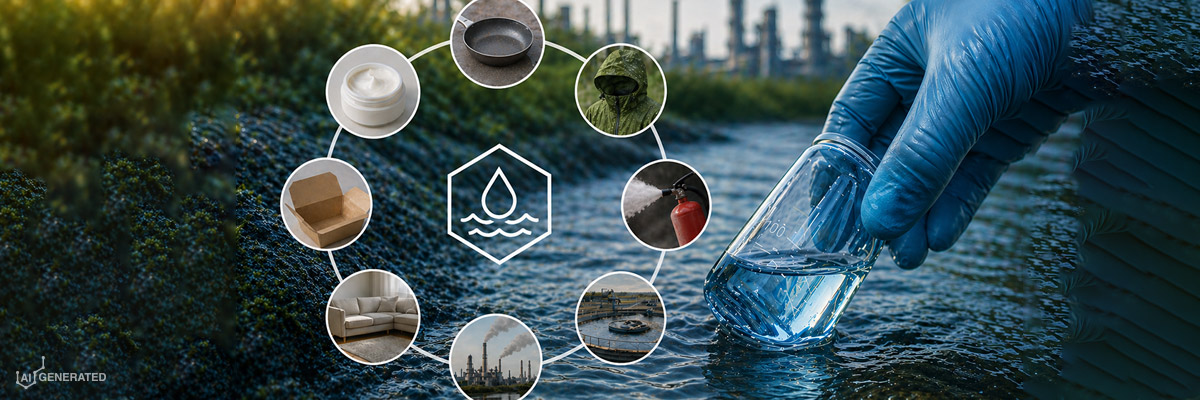
They are found in raincoats and frying pans, in fire-fighting foam and fast-food packaging, in sealing rings and medical implants: per- and polyfluoroalkyl substances, or PFAS for short. These synthetic chemicals have been a faithful servant to industry over the decades – but have now come to represent a global environmental problem. Since they will not disappear by themselves, modern technologies are needed to actively remove these “forever chemicals” from the environment and to prevent their further accumulation.
The chemistry behind the problem
PFAS encompass more than 12,000 different compounds, which are notable for their extremely stable carbon-fluorine bonds [1]. This chemical structure makes them waterproof, heat resistant, dirt-repellent – and therefore ideal for coatings, performance textiles and industrial applications.
The extreme stability of the carbon-fluorine bond is at once its greatest selling point – and its greatest environmental threat: the compounds barely break down naturally. Once released, they remain virtually indefinitely in the ground, in water, in the air and in living organisms.
Scientists are now finding PFAS in environmental samples all over the world, in drinking water and even in blood samples taken from many humans [1]. The health consequences are alarming: PFAS can disrupt the hormone system and our immune defences and are associated with various health conditions, including hormonal disorders and immunological disorders, as well as an increased risk of cancer. There is still so much more research to be done to understand the full impact in detail [1]. All the more important is to adopt a precautionary approach to keep contamination of the substances to a minimum in the first place. In 2024, the US Environmental Protection Agency (EPA) dramatically tightened its regulation: new PFAS compounds are subject to stricter testing, and six PFAS are now categorised as drinking water pollutants with maximum contaminant levels of 4 ng/L [2]. And the German Drinking Water Ordinance is planning to introduce strict limits for the most critically evaluated PFAS (these were summarised as sum parameters PFAS-20 und PFAS-4, see table at the end of this article).
But since significant amounts have already been released into the environment, prevention alone is not enough; measures to actively remove PFAS from the environment are also needed.
A ban on PFAS? Yes, but…
Studies increasingly show the harmful effects of PFAS on our health and the environment. This is why it is important and morally correct to regulate this class of substances and to prevent more of the chemicals finding their way into our environment. But that is easier said than done. Because while it may be questionable whether PFAS are strictly necessary in waterproof coats or even disposable items such as cardboard cutlery, there are many specialist applications that are genuinely reliant on the exceptional chemical properties of PFAS.
Take PTFE, better known as Teflon, for instance: this is used for a range of applications within medical technology, including in coatings or components for medical products such as endoscopes. A total ban could bring with it major technological limitations in this regard, as highlighted by Dr Janina Bolling, Head of Spectaris, Industry Association for Optics, Photonics, Analytical and Medical Technologies. Equivalent alternatives need to be developed and approved first [10].
It’s a similar story for the automotive sector: “modern-day vehicles and future vehicle technologies (e.g. traction batteries, fuel cells, performance electronics) would be inconceivable without PFAS,” according to a presentation by the German Association of the Automotive Industry (VDA). Components in EV batteries are reliant on PFAS, as are elements of fuel cells for hydrogen vehicles [11].
Plus, the actual risks of contamination are still the subject of ongoing research. For instance, PFAS have been found in the water vapour produced by fuel cell drives, released from the proton exchange membrane. Though the measured values are within the relevant guidelines, the finding illuminates the complexity and scope of the issue [12].
Separation and concentration: physical processes
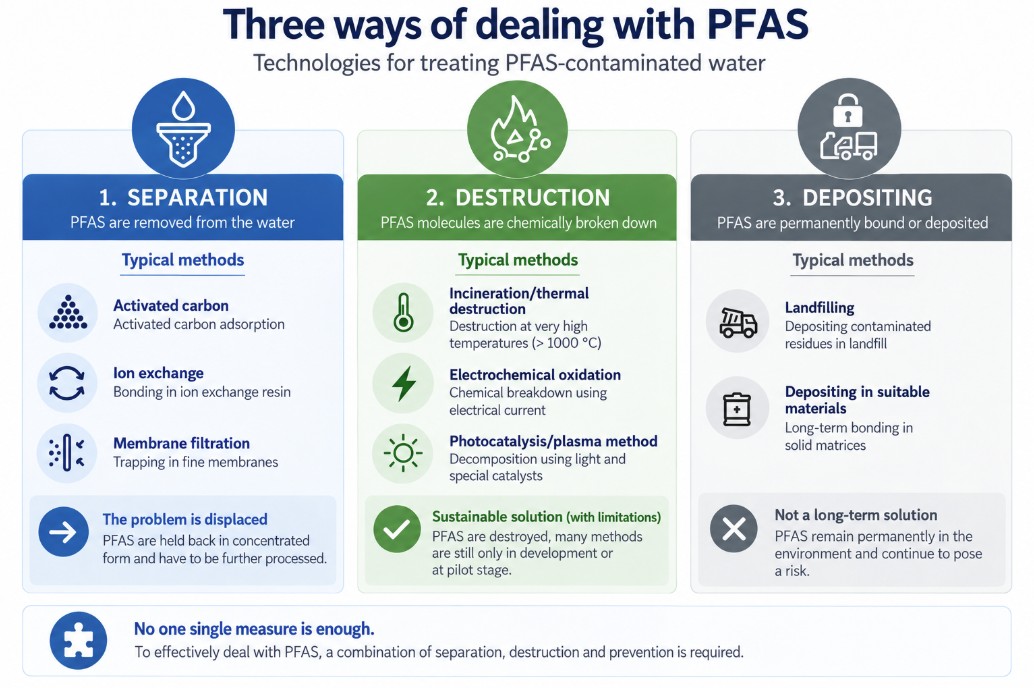
One obvious option for combatting PFAS is proven physical separation processes. EPA has categorised three technologies as the best methods available for treating drinking water: activated carbon adsorption, ion exchange and high-pressure membrane filtration (in the form of reverse osmosis and nanofiltration) [3].
Membrane filtration acts like a molecular sieve and can effectively remove PFAS from water. Nanofiltration utilises semi-permeable membranes with pore diameters in the region of just a few nanometres. This traps PFAS molecules, while smaller molecules and ions can pass through depending on their size and charge [4]. A drinking water treatment plant in France has demonstrated this effect in practice: following nanofiltration, the PFAS concentration in the treated water was below the detection limit of four nanograms per litre [5].
Reverse osmosis systems function in a similar way to nanofiltration, but work with higher pressures. In both instances, the influent stream of water is split into a cleaned permeate and the contaminated residual stream (the brine), with the latter accumulating a significant PFAS concentration [3].
Physical methods do not definitively remove PFAS, but rather they merely concentrate them in one place. n the case of perfluorooctane sulfonic acid (PFOS), as a representative of PFAS, studies with various membranes revealed separation rates of over 99 percent – and that is over a wide range of concentrations from 0.5 to 1500 mg/L [5]. On shorter PFBS molecules (perfluorobutane sulfonic acid) too, the membrane technology achieves removal efficiency rates of between 60 and 80 percent [6].
However, both membrane technologies have their challenges. Fouling – the continuous accumulation of colloidal and organic matter, precipitated salts or microbial growth on the membrane surface – significantly reduces the flow rate through the membrane [5]. As such, membranes must be replaced regularly. Furthermore, filtration merely displaces the PFAS problem; it doesn’t rectify it. After all, the forever chemicals accumulate in the brine and then have to be further processed or removed accordingly (more information in the section on chemical PFAS removal) – a drawback shared by all the physical separation methods.
Activated carbon adsorption uses the large specific surface of porous carbon particles (granular activated carbon, or GAC for short) to filter out PFAS. The effectiveness of the activated carbon varies depending on its pore structure and the contaminants to be removed: longer-chain PFAS, such as PFOS and PFHxS (perfluorohexane sulfonic acid) are best adsorbed in larger mesopores (2 to 50 nm), whereas short-chain PFAS permeate better in micropores with a diameter of less than 2 nm [6].
Generally speaking, however, the efficiency of the active carbon filter declines with smaller molecules, as with PFBA and PFPeA (perfluoropentanoic acid) for instance, with their four or five carbon atoms in the chain [6]. Another disadvantage is the limited capacity of the filters. These have to be regularly replaced and regenerated, representing a further increase in the cost of resources [7]. The charged adsorbent is typically thermally treated, i.e. incinerated at high temperatures.
An alternative means of removing PFAS rather than activated carbon is the use of ion exchange resins, especially in the case of short-chain representatives of the substance class. This method yields a removal rate of between 77 and 99 percent. This technique works because the majority of the PFAS found in water is present in the form of anionic species. The cationic end groups of the resins displace low-affinity anions (e.g. chloride) into the water and instead, bind to the anionic groups of PFAS, such as carboxylate (-COO–) or sulphonate (-SO₃–) [6].
According to EPA, the ecological footprint of ion exchangers is typically only one quarter of that of active carbon filters. The charged resins are ultimately removed from the filter and incinerated at temperatures in excess of 1000 °C, sufficient to destroy even the ultra heat resistant PFAS. As with the other physical separation methods, here too the thermal aftertreatment is essential to permanently eliminate the PFAS [7].
Destroying rather than just removing: chemical breakdown processes
While physical methods only collect PFAS and remove them from a medium such as water, destructive methods go a step further.
The simplest and most obvious method of chemically removing PFAS is thermal treatment, specifically incineration. Only by destroying the stable molecule structure is the PFAS problem actually resolved. In 2024, American company Veolia conducted their own tests that yielded destruction rates of over 99 percent for some PFAS, in peak cases even up to 99.9999 percent for PFOS and PFHxS. In 41 out of 45 samples, there was no evidence of PFAS residues remaining in the ash, slag or filter cake after the high-temperature treatment [8].
Through thermal treatment, the carbon-fluorine bonds are split by high temperatures (typically over 1000 °C). The resulting products of combustion are collected by means of precipitation or wet scrubbing or are further oxidised at increased temperatures. At the end of the process, fluoride ions are produced, as well as other anorganic and gaseous products.
However, the reaction processes are not yet all fully understood. There is a risk of as yet unknown secondary reactions and potentially toxic by-products, especially if incineration is combined with activated carbon [6].
As well as conventional incineration, other chemical processes are available that degrade PFAS.
The first of these alternative options is electrochemical treatment. Using special graphite electrodes, long-chain PFAS are converted to short-chain species by radical intermediate products (perfluoroalkyl radicals) and are ultimately broken down into carbon dioxide and hydrogen fluoride – a corrosive, toxic gas with its own unique challenges [6].
Another possibility is a photocatalytic treatment. This utilises photocatalysts, which promote light-driven decomposition reactions. However, unmodified titanium dioxide alone does not appear to be powerful enough, and even systems with titanium dioxide/tungsten trioxide coupled with ozone treatment only achieved removal rates of 25 percent in tests on six PFAS. Research into the resultant by-products and their potential toxicity is still lacking; this means that although this method may offer great potential (including on account of the low energy demand), it is not yet actually suitable for widespread application [6].
The list of methods doesn’t end there, however: from nanomaterials with adsorptive and reactive properties to microbially driven breakdown processes, there is a wide range of strategies to break the long-lasting PFAS back down.
Foam fractionation, for instance, shows hugely promising findings: the process uses the surface-active properties of PFAS and concentrates them in foam bubbles. Combined with ozone treatment (ozofractionation), individual PFAS compounds can be targeted and isolated from complex mixtures and, in individual cases, can achieve removal efficiency ratings of over 99 percent [6]. Nevertheless, this technique is less efficient when it comes to removing short-chain PFAS.
Ultrasonic treatment can also be used in the fight against PFAS. This method makes use of cavitation. This involves extreme forces that build when high-frequency ultrasound produces instable air bubbles in the water, which eventually collapse. This produces hotspots of around 5000 °C and 500 bar pressure. PFAS molecules can accumulate on the air-water boundary at these hotspots, where they are broken down by means of pyrolysis [9].
Prevention is the key
The list of options is long and varied. Yet with all the techniques already established and the many PFAS removal methods still being researched, it is important to remember one thing: the most effective strategy in the fight against PFAS contamination is to avoid the release of the chemicals in the first place.
PFAS limit values according to drinking water ordinance
The German Drinking Water Ordinance 2023 introduces binding limit values for per- and polyfluoroalkyl substances (PFAS) for the first time. This makes a distinction between two levels:
• Since 12th January 2026:
total limit value of 0.1 µg/L for a select group of 20 toxicologically relevant substances, which are summarised as PFAS-20.
• From 12th January 2028:
heightened total limit value of 0.02 µg/L for four substances categorised as critical (PFAS-4). [13]
The awareness of the far-reaching consequences of PFAS on humans and the planet is still relatively new. Thanks to an increasing focus among the general public and media, interest in research work on the subject is growing – and, consequently, so too is the opportunity to tap into new substance classes and, little by little, draw a line under the issue of PFAS. The most efficient and sustainable separation processes and decomposition methods possible are integral to this.
The challenge of eliminating PFAS from our environment is a compelling demonstration of just how closely interlinked chemistry, environmental technology and innovative processes are. This is what modern research is all about – and it needs precision analytics, reliable materials and highly effective methods.
Carl ROTH is here to help you with premium products and carefully conceived solutions for the laboratory and for research work. Discover our extensive range in our online shop at www.carlroth.com
Sources:
[1] Umweltbundesamt: FAQ zu PFAS https://www.umweltbundesamt.de/was-sind-pfas/
[2] US Environmental Protection Agency (EPA): Key EPA Actions to Address PFAS (2024) https://www.epa.gov/pfas/
[3] US Environmental Protection Agency (EPA): PFAS National Primary Drinking Water Regulation – Treatment Technologies Fact Sheet (2024) https://www.epa.gov/system/files/documents/2024-04/pfas-npdwr_fact-sheet_treatment_4.8.24.pdf
[4] STV Inc.: Emerging Technologies for PFAS Treatment: The Next Generation of Clean Water https://stvinc.com/insight/emerging-technologies-for-pfas-treatment-the-next-generation-of-clean-water/
[5] Interstate Technology & Regulatory Council (ITRC): PFAS Technical and Regulatory Guidance – Treatment Technologies https://pfas-1.itrcweb.org/12-treatment-technologies/
[6] PubMed Central (PMC): PFAS in water environments: recent progress and challenges (2025) https://pmc.ncbi.nlm.nih.gov/
[7] Schaller WTI: PFAS-Entfernung https://www.schaller-wti.de/inhalt/pfas-entfernung/
[8] Veolia North America: Veolia Completes Most Comprehensive Industry Testing on PFAS Waste (2024) https://www.veolianorthamerica.com/
[9] Interstate Technology & Regulatory Council (ITRC): PFAS Technical and Regulatory Guidance – Ultrasonication Treatment https://pfas-1.itrcweb.org/12-treatment-technologies/
[10] LABORPRAXIS-Interview: „PFAS-Beschränkungen: Wichtig, aber mit Augenmaß“ https://www.laborpraxis.vogel.de/
[11] VDA-Präsentation: PFAS in der Automobilindustrie (pdf) https://www.vda.de/
[12] Lange, T. Et al., Investigating PFAS emissions of light- and heavy-duty fuel cell electric vehicles”, Journal of Power Sources Advances 32 (2025), DOI: 10.1016/j.powera.2025.100171; https://www.sciencedirect.com/
[13] Bundesgesundheitsministerium: Trinkwasserverordnung 2023 (TrinkwV) https://www.gesetze-im-internet.de/trinkwv_2023/TrinkwV.pdf