

Lungs vs. smoke
Coughing as a protective reflex
Even the slightest irritation can set a remarkably complex protective mechanism in motion: we cough. Unpleasant though it may be, coughing serves a vital physiological purpose. It is a protective reflex that enables the airways to respond to foreign bodies, mucus and physical or chemical irritants.
But how does the body sense that something disruptive has entered the airways? And how is that irritation translated into a cough within moments? The answer lies in a finely tuned interplay between sensory nerve cells, neuronal signalling and the respiratory muscles.
From irritation to reflex
The cough reflex begins when irritation is detected in the airways. Sensory nerve endings register mechanical, thermal or chemical stimuli and translate them into electrical signals. These signals then travel via afferent (‘incoming’) nerve fibres — primarily those of the vagus nerve — to the brainstem.
In the brainstem, the incoming signals are processed and the movements needed for coughing are coordinated. Efferent (‘outgoing’) nerve pathways then activate the larynx and respiratory muscles. After a deep inhalation, the glottis briefly closes while the expiratory muscles build pressure in the chest. When the glottis opens again, air is forced out at high speed, helping to clear secretions, foreign bodies and other disruptive substances from the airways.
Why cigarette smoke is such an irritant
Cigarette smoke is not a single substance, but a complex mix of particles and gaseous compounds. As tobacco burns, it generates numerous chemical compounds, many of them harmful to health. When components of smoke enter the airways, they come into contact with mucous membranes and sensitive nerve fibres, where they can trigger irritation and inflammatory responses.
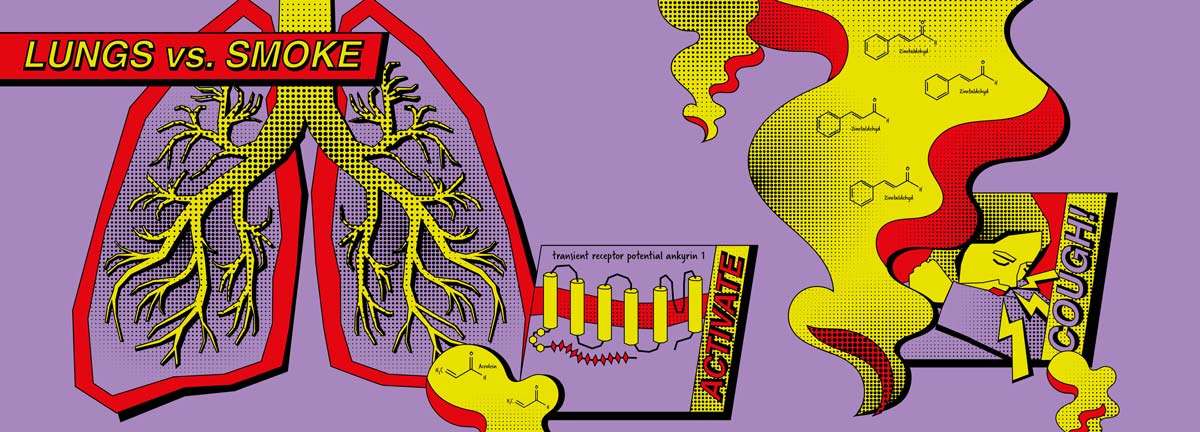
One reactive component of tobacco smoke is acrolein. This unsaturated aldehyde is formed during combustion processes and is highly irritating to the eyes and airways. In the respiratory tract, acrolein can also react with proteins and other biological structures. It is also one of the chemical irritants detected by specialised sensory nerve cells.
At the molecular level, this is where the story leads back to coughing: the ion channel TRPA1 has an important role in recognising acrolein.
When the chemical sensor responds
TRPA1 belongs to a family of ion channels involved in sensing a range of environmental stimuli. It is found, among other places, in sensory nerve cells whose fibres supply the airways. There, it can be activated by various chemical irritants, including acrolein.
Once TRPA1 is activated, the ion channel opens and positively charged ions flow into the nerve cell. This alters the cell’s electrical excitability and can generate nerve signals that are passed on via the vagus nerve to the brainstem. In this way, the perception of a chemical irritant can feed into the neuronal processes that help trigger the cough reflex.
TRPA1 therefore acts as an important molecular interface between certain chemical irritants in the airways and their detection by the nervous system.
From irritation to scientific insight
Current knowledge of TRPA1’s role in sensing chemical irritants is built on a combination of experimental approaches. Researchers examine, for example, which cells express the ion channel, how it responds to specific substances and which cellular processes are set in motion after activation.
These studies use molecular biological methods to detect RNA and proteins, alongside cell models and functional analyses of ion-channel activity. Changes in intracellular calcium concentration can also reveal how cells respond when an ion channel is activated. Together, these approaches help connect molecular processes with physiological responses.
At the same time, research makes clear that many questions remain open. While TRPA1’s function in sensory nerve cells has been studied in considerable detail, its role in non-neuronal tissues of the airways, for example, still calls for further investigation.
Supporting Science. Improving Lives.
Turning individual observations into robust scientific knowledge takes precise analytics, reproducible experimental conditions and materials researchers can trust. Carl ROTH supports this work with high-quality chemicals, reagents, laboratory supplies and tailored solutions for a wide range of experimental needs.
Whether you are exploring the fundamental mechanisms of irritant sensing or identifying new links in respiratory research, Carl ROTH offers the dependable products and expertise to help turn precise research into meaningful progress.
Find the right products and solutions for your laboratory at www.carlroth.com.
Sources:
https://www.lungeninformationsdienst.de/aktuelles/schwerpunktthemen/husten
https://www.thieme-connect.de/products/ejournals/pdf/10.1055/a-0808-7409.pdf
https://edoc.ub.uni-muenchen.de/23095/1/Zehfuss_Franziska.pdf
https://www.dkfz.de/forschung/translationale-zentren/ncpc/stabsstelle-krebspraevention/downloads-1