


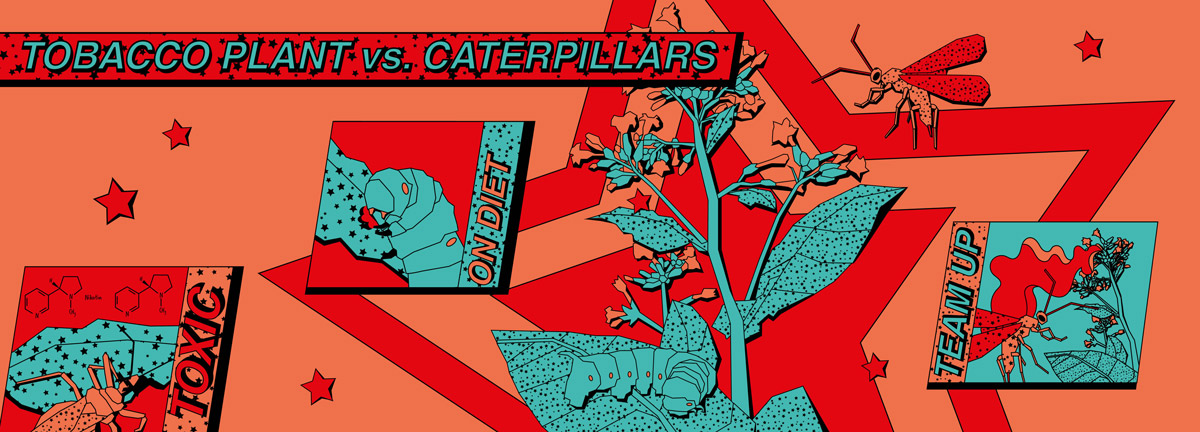
Wild Tobacco vs. Caterpillars
A two-pronged defence against hungry caterpillars
No one likes being eaten – plants included. But firmly rooted in the ground, they cannot simply move out of harm’s way. So how do they defend themselves against hungry herbivores?
The plant kingdom is far from defenceless, and wild tobacco, Nicotiana attenuata, is a striking example. When tobacco hornworm caterpillars (Manduca sexta) feed on its leaves, the encounter has consequences for both plant and caterpillar. The tobacco plant responds with several layers of defence – a highly specific programme precisely tailored to Manduca caterpillars.
How the plant recognises a caterpillar attack, which chemical signalling pathways are involved and why even the timing of its response matters are all being studied intensively. Researchers know that wild tobacco mounts a direct chemical defence, producing a range of protective compounds and concentrating them around the damaged tissue. At the same time, it releases volatile organic compounds. These scents attract the herbivores’ natural enemies, including predatory bugs, and so provide an indirect line of defence.
The tried-and-tested all-purpose weapon: nicotine
As soon as the plant is damaged, concentrations of jasmonic acid and its salts rise rapidly in the injured tissue. These compounds selectively activate signalling pathways that affect the expression of numerous genes and, in turn, a range of defence responses. In most cases, this brings the tried-and-tested all-purpose weapon into play: nicotine.
Wild tobacco continually produces low concentrations of the neurotoxin nicotine. After injury, however, nicotine levels around the damaged area rise roughly tenfold, helping to incapacitate pests. The alkaloid binds to nicotinic acetylcholine receptors and can disrupt signal transmission in the nervous system. This makes it an effective chemical defence against many plant-eating insects and other herbivores.
For tobacco hornworm caterpillars, however, the story is different. Manduca sexta is adapted to its nicotine-rich diet and can tolerate large quantities of the alkaloid. The caterpillar even stores nicotine in a gland as protection against predators. Simply producing more nicotine would therefore be futile – and wild tobacco has adapted accordingly. But how does it know what is nibbling at its leaves?
As the caterpillar feeds, compounds in its saliva are deposited on the wounded plant tissue. These include fatty acid–amino acid conjugates, or FACs. In Nicotiana attenuata, FACs trigger more specific responses than purely mechanical damage does.
Intriguingly, jasmonates also control and regulate these more specific responses. Rather than acting as a simple on–off switch, they fine-tune the processes involved with remarkable precision.
Timing is everything
Wild tobacco’s response to Manduca infestation is not only finely tailored to this particular caterpillar; it also unfolds in a carefully timed sequence. The plant’s defences do not reach full strength straight away. Several days may pass between the first feeding damage and the fully developed response. For Nicotiana attenuata, that delay may offer an ecological advantage.
Young tobacco hornworm caterpillars are small and initially consume relatively little plant material, so damage to wild tobacco remains limited. As they grow, however, their appetite increases substantially. Older, larger caterpillars are also better able to leave their host when conditions become unfavourable and move on to neighbouring plants.
Scientific models based on field observations suggest that when an infested plant’s defences rise only after a delay, larger caterpillars may move to neighbouring plants with weaker defences. This can limit further feeding damage to the wild tobacco. The delay is therefore not simply a sluggish response, but a finely tuned optimisation – an evolutionary adaptation to the herbivore’s changing behaviour as it develops.
Perfume for indirect defence
Wild tobacco has another line of defence: scent. To reinforce its protection, Nicotiana attenuata releases a chemical signal into the air.
In undamaged tobacco plants, open flowers release the sesquiterpene (E)-α-bergamotene at night. Adult tobacco hornworm moths detect the scent and use it to locate the flowers for pollination. In this context, bergamotene supports the reproduction of wild tobacco.
After a caterpillar attack, however, (E)-α-bergamotene takes on a second role in the leaves. They release larger quantities of the compound, particularly during the day, attracting predatory bugs of the genus Geocoris – natural enemies of the tobacco hornworm. Following the scent signal, the bugs prey on the eggs and young caterpillars of Manduca sexta on the tobacco plant.
The same compound can therefore mediate two distinct ecological interactions: between plant and pollinator at night, and between the plant and its herbivore’s natural enemies during the day. What changes is when and where the signal is released.
Why wild tobacco matters to research
How does a plant recognise what is feeding on it? How does it coordinate its defences? And what role do other organisms in its environment play? Wild tobacco allows researchers to explore these complex interactions under natural conditions.
Researchers are also investigating how these natural defence mechanisms might be put to use. A better understanding of how plants respond to herbivores and recruit their natural enemies could pave the way for more targeted, sustainable approaches to crop protection.
Supporting Science. Improving Lives.
In the laboratory, the processes at work inside wild tobacco can be traced down to individual signalling molecules, genes and metabolic pathways. Modern analytical techniques show which compounds are involved, how their concentrations change and which responses they trigger.
Carl ROTH supports this research with a comprehensive range of chemicals and reagents, laboratory supplies and consumables for sample preparation, analytical workflows and molecular biology. Expert, application-focused advice helps scientists choose the right products with confidence and find practical solutions to specific laboratory challenges.
Explore products and solutions designed to keep your laboratory work moving forward at www.carlroth.com.
Sources:
https://www.ice.mpg.de/79267/research_report_358989?c=2812&force_lang=de
https://www.mpg.de/924959/pflanzliche-abwehrstrategien-teil-2-duftstoffe