



Algae on our plates
The green miracle of tomorrow’s diet?
Many of us are now familiar with algae as a food ingredient through sushi. Sushi masters use nori seaweed (a type of algae) to conjure up delicious creations from rice and raw fish. The seaweed sheets are used primarily to provide structure and hold the sticky rice together. Yet they are much more than just a binding agent.
Algae provide a protein content comparable to that of soya, contain valuable fibre and minerals, as well as vitamin B12, which is normally found exclusively in animal products. Although only a portion of this is in a form that humans can utilise, it is nonetheless an advantage over traditional plant-based products.
Some species are proving to be genuine superfoods, each with their own specific benefits. Of particular interest is the group of microalgae – not large sheets of algae, but tiny, often single-celled organisms with a high reproduction rate. For example, the microalga Phaeodactylum tricornutum produces particularly large quantities of omega-3 fatty acids, whilst Chlorella vulgaris is characterised by a particularly high protein content of around 50 per cent. Under suitable conditions in dedicated algae farms, the nutrient content of individual species can even be optimised further. “Compared with land plants, our algae contain a factor of 10 more nutritionally valuable components,” emphasises Dr Ulrike Schmid-Staiger, who cultivates algae for food technology applications at the Fraunhofer Institute for Interfacial Engineering and Biotechnology (IGB).
Environmental benefits
Algae also require significantly less land than traditional crops. For example, one hectare can yield around 30 tonnes of maize per year – or 150 tonnes of algae cultivated in suitable photobioreactors. The efficiency of algae lies not only in its reduced space requirements, but also in the fact that almost the entire biomass can be utilised, whereas with conventional field crops, many parts – such as leaves and stalks – are unsuitable for direct use in the food industry. Given the ever-growing world population, this represents a significant advantage in terms of securing the global food supply. Researcher at the IGB, Schmid-Staigerm even believes that peak production levels of around 900 tonnes of algae biomass per hectare per year are achievable.
Green tanks for good nutrition
In bioreactors, the growth conditions for the algae can be precisely controlled and adjusted to produce the desired product: providing the algae with more nutrients boosts protein production, whilst in a nutrient-poor medium, the algae shift their metabolism towards carbohydrates and fats. The cultivated algae are harvested and are currently marketed primarily in tablet form as dietary supplements. Macroalgae – well-known varieties such as nori, used in sushi rolls – undergo further specialised processing. They are dried and finely ground to break down the cell walls and release the proteins they contain. Added enzymes, such as those from an algae-eating snail, aid the subsequent extraction process. To do this, the powder is soaked in water, heated and stirred. Centrifugation is used to separate the proteins from the mixture – yielding up to 90 per cent in the case of macroalgae. The algae protein is now ready.
Amino acid composition of various algae and animal products
The table shows the levels of nine essential amino acids in various species of algae, as well as in eggs and soya beans for comparison. The FAO (Food and Agriculture Organisation of the United Nations) recommendation is given as a reference value.
Figures are given in grams per 100 grams of protein.
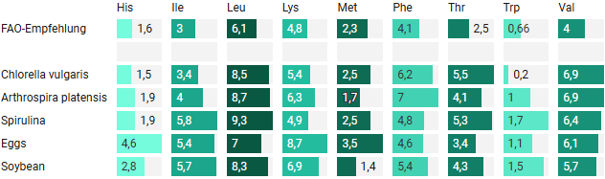
Source: DOI: 10.3389/fnut.2023.1277343 (Supplementary Material: Table 1)
Created with Datawrapper
Sausages and fizzy drink made from algae?
The potential of algae, however, extends far beyond that of a dietary supplement in the form of capsules and tablets. Researchers at Fraunhofer IGB are experimenting with various recipes for pasta, muesli bars, spreads and vegan sausages. They have also already incorporated algae extracts into barbecue sauce, beer, lemonade and gin. The two main challenges here are
- 1. to neutralise the fishy taste of the algae and
- 2. to bleach their green colour.
After all, neither a fishy flavour nor a greenish-brownish appearance suits every food product. Here, the scientists are experimenting with various flavourings and herbs that are capable of masking the fishy taste where necessary. In some cases, it may even be desirable – for example, as a flavouring in pesto or in a future vegan fish alternative. The algae (or seaweed) flavour would be ideal in this case, but the green colour remains a deal-breaker. Who would want to eat a green trout fillet?
And this is where the researchers are powerless. Because it’s probably not possible to produce a white “vegan Nile perch” from green algae. Either the pigments in the algae themselves are the much sought-after proteins, or they are so closely bound to the target proteins that they cannot simply be removed from the product without damaging the proteins. But perhaps green, algae-based “veggie fish” will one day become the next big thing – who knows….
What’s the catch?
Nutrient-rich, space-saving to cultivate – and therefore kind to agricultural land and the climate – and versatile in their uses: given these advantages, we might well wonder why algae haven’t long since played a greater role in the food industry.
In fact, the world of algae products isn’t quite as “green” as it seems. This is partly down to the algae themselves, and partly to the exaggerated marketing of “green” products. In the case of spirulina in particular – i.e. products containing components of cyanobacteria (“blue-green algae”) – the German consumer advice service (Verbraucherzentrale) criticises the often misleading labelling of these products. In particular, the German consumer advice service points out that only around 20 per cent of the vitamin B12 contained in these products is usable by humans. Spirulina is therefore unsuitable as a source of B12, particularly for those following a vegan diet. Research has even suggested that “vitamin B12 analogues block the absorption of ‘real’ vitamin B12 by occupying the transport systems”, according to the German consumer advice service website (Verbraucherzentrale.de). It also warns that there are no quality standards for spirulina products. Algae may be contaminated with heavy metals, PAHs and toxins – and without regular checks, in the worst-case scenario, this contamination could go unnoticed by consumers.
Finally, the German consumer advice service takes a critical view of the iodine content. This is very high in many algae products. Consumers can therefore quickly reach the maximum daily intake of 500 micrograms of iodine per day recommended by the German Nutrition Society (DGE). There is often a lack of clear labelling and warnings in this regard.
However, penalising algae producers for failing to meet labelling requirements would probably be a wasted opportunity. After all, they are still in their infancy on the European food market. Whilst most of us have probably already consumed algae products – for example, in the form of alginate (a vegan gelatine substitute) or carrageenan (a stabiliser in many dairy products such as yoghurt and spray cream) – the true nutritional wonders remain completely unknown to most consumers.
IDB researcher Böhme likes to recount a highlight from her workshops on algae extracts and their use in food. She says the seaweed-walnut ice cream is particularly surprising; according to her, it doesn’t taste fishy at all, but simply like walnut ice cream. And who would say no to a walnut ice cream?
Novel Foods
The Regulation (EU) 2015/2283 on novel foods has been in force in the European Union since 1 January 2018 [1]. It defines “novel foods” as foods that were not used for human consumption to a significant degree in the EU prior to 15 May 1997. It is not necessarily the case that the foodstuffs themselves must be new; it may also be a previously unknown method of processing that makes a product a “novel food”.
Anyone wishing to place a new product on the food market must first submit an application for authorisation to the European Commission. The European Food Safety Authority (EFSA) may then carry out a safety assessment. Only once a product has been assessed favourably and included in the Union list may it be placed on the market [1].
Key requirements are: the product must not pose a health risk, it must not mislead consumers, and it must not lead to nutritional deficiencies in consumers if it is intended to replace another foodstuff in normal consumption [2].
[1] Bundesamt für Verbraucherschutz und Lebensmittelsicherheit (BVL) [Federal Office of Consumer Protection and Food Safety]: Novel Food
https://www.bvl.bund.de/DE/Arbeitsbereiche/01_Lebensmittel/03_Verbraucher/06_NovelFood/lm_NovelFood_node.html
[2] AGES – Österreichische Agentur für Gesundheit und Ernährungssicherheit: Neuartige Lebensmittel (Novel Food)
https://www.ages.at/mensch/ernaehrung-lebensmittel/lebensmittelinformationen/neuartige-lebensmittel
Sources:
Fraunhofer-Institut für Verfahrenstechnik und Verpackung (IVV): Grün isst die Zukunft.
Verbraucherzentrale: Spirulina – viel Grün und wenig dahinter
https://www.verbraucherzentrale.de/wissen/lebensmittel/nahrungsergaenzungsmittel/spirulina-viel-gruen-und-wenig-dahinter-21053
Verbraucherzentrale: Algen im Fokus: Nährstoffquelle mit Gesundheitsrisiko?
https://www.vzhh.de/sites/default/files/medien/136/dokumente/2025-02-04_Verbraucherzentrale_Bericht_Marktcheck-Algen.pdf