



Mouse Brain vs. Depression
How the brain keeps its balance under stress
Why stress affects some brains more than others
Stress can leave its mark on the brain. So why do some people cope better with difficult situations than others?
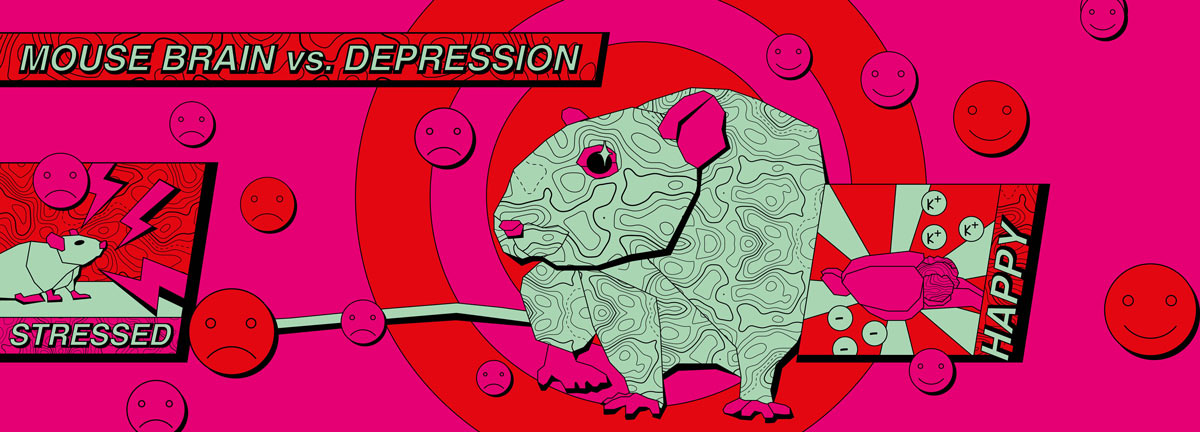
A study published in 2014 offers an intriguing clue. Researchers examined mice repeatedly exposed to social stress. Some became withdrawn and showed less interest in rewards, while others proved remarkably resilient.
The key difference was not a weaker response to stress. Instead, the resilientmice appeared to have a particularly effective compensatory mechanism. [1]
How does the mouse brain regulate its activity after stress?
The answer lies partly in the brain’s reward system. Here, dopamine-producing nerve cells help regulate motivation and the way rewards are processed.
These cells generate electrical signals using tiny channels in their membranes. Charged particles pass through the channels, influencing how active the nerve cells are.
In mice vulnerable to stress, the researchers found stronger excitatory ion currents. As a result, the nerve cells they studied became overactive.
Yet in resilient mice, the picture was more surprising: the excitatory currents were stronger still, but nerve-cell activity remained largely normal.
Why? Stronger potassium currents were also present, offsetting the extra excitation. Put simply, the brain pressed harder on the accelerator – but had stronger brakes to match.
This self-regulating process is known as homeostatic plasticity. It helps nerve cells maintain stable activity, even under stress.
Notably, researchers were able to trigger a similar compensatory response in stress-susceptible mice in the laboratory. The animals then displayed fewer depression-like behaviours. [1]<br/>
What can the mouse brain tell us about depression?
The findings offer a different way to think about stress and resilience. Resilience does not always mean a weaker response to stress. It may depend instead on how effectively the brain compensates.
Of course, a mouse that withdraws or loses interest in rewards cannot be directly compared with a person experiencing depression. The condition is complex, with biological, psychological and social factors all playing a part.
Mouse studies cannot explain the full complexity of depression in people. They can, however, help researchers pinpoint mechanisms involved in stress and depression-like behaviour.
That is where their value lies: understanding how the brain restores its own balance may point towards new ways of treating depression. [1, 5]
What new approaches are being explored for treating depression?
Could researchers harness the brain’s own protective mechanisms?
A further mouse study in 2016 explored this possibility, focusing on potassium channels known as KCNQ channels. Compounds that open these channels were able to reduce excessive activity in certain nerve cells. The mice also showed fewer depression-like behaviours.
One of these compounds was retigabine, also known as ezogabine. [2]
The approach has also been tested in people. In a small clinical trial published in 2021, involving 45 participants, those given ezogabine showed greater improvements than the placebo group in certain depressive symptoms and in their ability to experience pleasure.
There was an important caveat: the trial did not meet its prespecified primary endpoint of demonstrating a statistically significant change in how the brain processes rewards. [3]
A further analysis published in 2025 suggested changes in the activity and connectivity of certain brain regions. But because it used data from the same clinical trial, it did not provide independent confirmation. [4]
The findings are encouraging, but they do not establish a new treatment. Larger studies with longer follow-up periods are still needed.
Why researchers study the mouse brain
What connects stress, nerve-cell activity and behaviour? Studies in mice allow researchers to trace these links right down to the level of individual ion channels.
Modern laboratory techniques allow scientists to measure electrical signals from nerve cells and deliberately influence their activity. This helps reveal the biological mechanisms involved in the stress response.
How far these findings can be translated to people remains an open question. Further clinical studies will be essential.
One insight stands out: a resilient brain does not need to prevent stress altogether. What matters may be its ability to restore balance.
Understanding that process could, in time, open up new directions in depression research.
Supporting Science. Improving Lives.
From individual nerve cells to complex molecular mechanisms – progress in research depends on having the right tools.
Understanding how stress affects the brain means looking closely at nerve cells, proteins and molecular signalling pathways. That calls for reliable reagents, precise analytical methods and high-quality laboratory supplies.
Carl ROTH supports your research with an extensive range of products for life science, biochemistry and everyday laboratory work.
Whether you are exploring neuronal processes, analysing proteins or preparing biological samples, our online shop has products to support a wide range of research applications.
Explore our comprehensive range and benefit from dependable product quality, expert advice and plenty of choice – because your research deserves tools you can trust.
Explore the Carl ROTH online shop – and equip your lab for what’s next!
Sources:
1. Friedman, A. K. et al. (2014): Enhancing Depression Mechanisms in Midbrain Dopamine Neurons Achieves Homeostatic Resilience. Science 344, 313–319.
https://pmc.ncbi.nlm.nih.gov/articles/PMC4334447/
2. Friedman, A. K. et al. (2016): KCNQ channel openers reverse depressive symptoms via an active resilience mechanism. Nature Communications 7, 11671.
https://www.nature.com/articles/ncomms11671
3. Costi, S. et al. (2021): Impact of the KCNQ2/3 Channel Opener Ezogabine on Reward Circuit Activity and Clinical Symptoms in Depression. American Journal of Psychiatry 178, 437–446.
https://pmc.ncbi.nlm.nih.gov/articles/PMC8791195/
4. Morris, L. S. et al. (2025): Effects of KCNQ potassium channel modulation on ventral tegmental area activity and connectivity in individuals with depression and anhedonia. Molecular Psychiatry 30, 3686–3694.
https://www.nature.com/articles/s41380-025-02957-7
5. Post, R. J. & Warden, M. R. (2018): Melancholy, anhedonia, apathy: the search for separable behaviors and neural circuits in depression. Current Opinion in Neurobiology 49, 192–200.
https://pmc.ncbi.nlm.nih.gov/articles/PMC6042519/
