



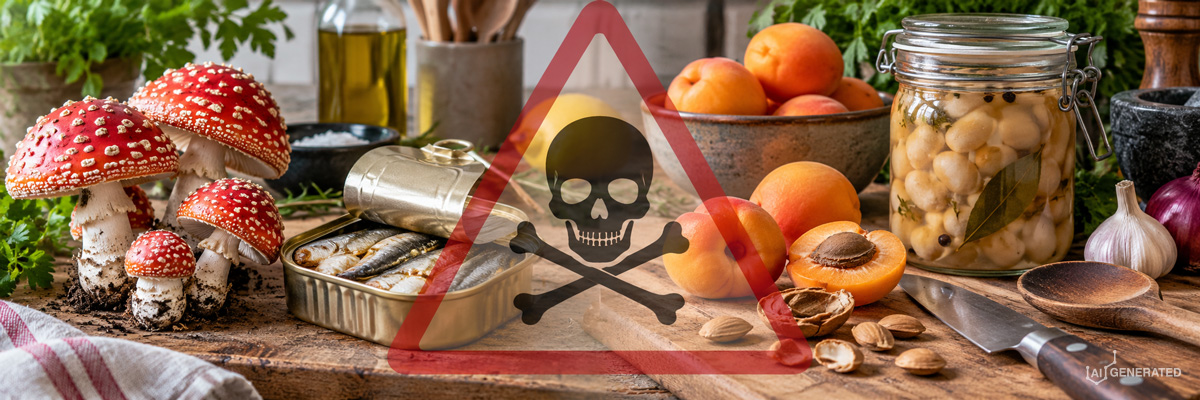
The dose makes the poison
When food becomes dangerous
As summer draws to a close and the first signs of autumn appear, people in many places head for the woods. Armed with a basket, knife and brush, they are looking not only for peace, fresh air and a chance to unwind, but above all for mushrooms.
Prime spots for field mushrooms, chanterelles or even porcini – all destined for the frying pan – are often closely guarded secrets. But here, as in so many areas of life, it pays to know what you are doing. When gathering wild food in particular, poor identification skills and lack of experience can have serious consequences for health, sometimes even fatal ones. Many mushrooms are inedible, and some are poisonous.
Around 155,000 fungal species have so far been scientifically described worldwide [1] – while the true diversity is estimated at roughly 2.5 million species. More than 2,000 fungal species are documented as edible; alongside them are numerous poisonous and potentially fatal species [2].
Mushrooms containing amatoxins are particularly dangerous: they are thought to account for more than 90% of fatal mushroom poisonings [3]. One of them is the death cap, Amanita phalloides, one of the leading causes of fatal mushroom poisoning worldwide. What makes it especially treacherous is its resemblance to edible species such as the field mushroom.
A fatal mistake: the death cap mushroom
With death cap mushroom poisoning, every minute counts. The course of the illness is typical and severe: Six to 24 hours after ingesting green death cap mushrooms, severe abdominal pain, nausea, vomiting, and cholera-like diarrhea occur. During the hepatic phase of poisoning, 12 to 48 hours after the meal, cytolytic hepatitis develops. As early as 24 to 72 hours after eating the mushrooms, acute liver and kidney failure can occur – leading to complications such as coagulation disorders, seizures, severe brain damage, and hepatic coma.
Activated charcoal can bind the toxin, but only if it is given very early. Without rapid intervention, the chances of survival are extremely poor. Doctors will also usually replace lost fluids and electrolytes and treat the liver failure. Even then, however, it may no longer be possible to stop the organs from failing.
In the case of A. phalloides, it is the so-called amatoxins that begin their destructive work once they are ingested. For humans, the lethal dose of α-amanitin is estimated at just 0.1 mg/kg body weight. This means that even a small 30-gram fruiting body with an average α-amanitin content of 0.03% (9 mg) can be fatal to an adult. For children, as little as 5 to 10 grams of mushroom may be enough.
This group of toxins comprises ten heat-stable bicyclic oligopeptides. Its main active compounds, α- and β-amanitin, resist the peptidases involved in digestion. They can therefore reach our cells, where they bind to RNA polymerase II, suppress gene transcription and in turn inhibit the production of many essential proteins. Three medicines – penicillin G, silibinin and N-acetylcysteine (NAC) – are also used as antidotes. Penicillin G and silibinin mainly inhibit the uptake of amatoxins into liver cells via the organic anion transporter OATP-1B3 [3]. NAC acts as an antioxidant and helps regenerate glutathione.
How the fly agaric got its name
Poisoning from death cap mushrooms is an extreme example, but many other types of mushrooms are also dangerous. Muscarine was the first mushroom toxin ever identified: it was discovered in 1869 in the fly agaric (Amanita muscaria), and split gills, some funnel mushrooms, and other mushroom species also contain this toxin. The Rinnig-frosted funnel mushroom, for example, is also known as the false champignon – a name that already hints at which mushroom this species is sometimes mistaken for.
Chemically, muscarine is an alkaloid named 2-methyl-3-hydroxy-5-trimethylammoniomethyloxolane. Only when the mushroom is damaged – for example by cutting, cooking or digestion – does an enzyme release the fungal toxin from a precursor molecule. This common natural principle helps the mushroom defend itself against predators. Here too, the often-quoted maxim applies: ‘The dose makes the poison.’ Around 180 mg of muscarine is fatal to an adult. In the deadly fibrecap (Inocybe patouillardi), this quantity is present in roughly 500 g of fresh mushroom at an average muscarine content of 0.037%. Compared with the death cap, considerably more is therefore required before the dose becomes life-threatening.
Muscarine disrupts signalling by the neurotransmitter acetylcholine. Because its structure resembles that of acetylcholine but it is not broken down by acetylcholinesterase, it causes prolonged stimulation of nerve cells through the parasympathetic nervous system. Effects range from increased salivation and tear production, sweating, vomiting and diarrhoea to breathlessness and circulatory collapse; in the worst case, the poisoning ends in fatal cardiac paralysis. Alongside activated charcoal to bind the toxin and the replacement of lost fluids and electrolytes, doctors administer atropine. This parasympatholytic drug, or anticholinergic, blocks muscarinic acetylcholine receptors and in this way counteracts the effects of both acetylcholine and muscarine.
From toxin to measurement
A substance that is highly dangerous in the body becomes a clearly defined analyte in the laboratory. High-purity natural products and reference substances support the development of chromatographic methods, the unambiguous identification of substances and the validation of measurement results. An overview of relevant substances is available in Carl ROTH’s Natural Products section.
Botulinum neurotoxin: a potent poison with many faces
We now leave the world of fungi, although it contains many more toxins than the two already discussed. The neurotransmitter acetylcholine, however, remains central to the story, because it is also targeted by another, much better-known poison: botulinum toxin (BTX), also called botulinum neurotoxin (BoNT) or, more commonly, Botox.
Strictly speaking, this is not a single toxin. The term refers to several very similar neurotoxic proteins produced by various species of Gram-positive, obligate anaerobic, spore-forming rod-shaped bacteria of the genus Clostridium .
Clostridium bacteria and their spores occur almost everywhere in soil and aquatic sediments. Although exposure can occur in several ways, the toxin most often enters the body in contaminated food, causing the feared condition known as foodborne botulism. Typical sources include foods that have not been heated, or not heated sufficiently, and are stored under anaerobic conditions – preserved meat and vegetables, fish products, or salads made from beans that were not cooked thoroughly before preserving. The bacteria also produce gases as they grow, so a tin or jar lid bulging outwards under pressure is an important warning sign. Gas escaping when preserved food is opened may likewise indicate contamination. Such foods should be discarded or, at the very least, heated thoroughly. At temperatures above 85 °C, BoNT loses its toxicity after approximately one minute; at 80 °C, after five minutes. Freezing, by contrast, does not kill the spores.
Oral botulinum toxin (BoNT) poisoning sometimes begins with nonspecific gastrointestinal symptoms such as nausea, vomiting, and diarrhea. Regardless of the route of exposure, however, botulism is characterized by an acute, afebrile illness with a typically symmetrical, descending, flaccid paralysis that begins in the head. Unlike muscarine, BoNT does not overexcite nerve cells but rather inhibits the release of acetylcholine – particularly at the synapses between nerve and muscle cells, the motor end plates. The result is progressive muscle weakness and paralysis, potentially leading to respiratory paralysis, which is always fatal if left untreated.
BoNT is considered the most potent poison known. LD50 values in mice are just 3 ng/kg body weight by inhalation and 4 ng/kg body weight by subcutaneous exposure. Even minute quantities of the toxin can trigger botulism when unheated, contaminated food is eaten.
Several antitoxin treatments are available for the botulinum toxin group. However, they can only prevent additional toxin from entering the body’s cells, so they too are effective only very soon after poisoning. Doctors may also try symptomatic treatment with cholinesterase inhibitors, with the aim of keeping the remaining acetylcholine in the synaptic cleft for longer.
Fun fact: It is precisely this muscle-paralysing effect that is now harnessed in the widespread cosmetic use of highly diluted Botox preparations for wrinkle treatment – effectively a localised poisoning.
Bitter almond, deadly acid
What mushrooms are to autumn, almonds are to winter. They appear in stollen and marzipan, decorate Christmas biscuits and add flavour and texture to muesli. Familiar sweet almonds can also be eaten raw. Bitter almonds, by contrast, contain the cyanogenic glycoside amygdalin, which releases highly toxic hydrogen cyanide in the body – up to 3,000 mg per kilogram of bitter almonds. The kernels of stone fruits belonging to the genus Prunus, including apricots, sour cherries, plums and peaches, also contain cyanogenic glycosides. Cyanides – the salts and other compounds of hydrogen cyanide – have a comparable effect. Potassium cyanide is probably the best-known example.
Because hydrogen cyanide is so highly toxic, poisoning can become fatal very quickly. When taken orally, one to two mg/kg body weight is enough to cause fatal poisoning. One bitter almond contains approximately 1 mg of amygdalin; in children, therefore – depending on body weight – as few as five to ten bitter almonds may prove fatal. Cyanides can also be absorbed through the skin or inhaled into the lungs, but heating, for example during baking, reduces the problematic precursors to harmless levels.
Hydrogen cyanide can cross lipid membranes. Its lethal action takes place in the mitochondria, where it binds to the central iron(III) ion of the haem a3 cofactor in cytochrome c oxidase. This blocks a key enzyme in the respiratory chain. Because hydrogen cyanide binds to the haem a3 cofactor more strongly than oxygen does, it prevents further oxygen from binding. It also forms complexes with the iron in haemoglobin and myoglobin. Depending on the amount absorbed, death from cellular asphyxiation can occur within minutes.
Hydrogen cyanide poisoning also demands immediate treatment. Several antidotes are available, chiefly 4-dimethylaminophenol (4-DMAP) and sodium thiosulphate. Sodium thiosulphate is intended to speed up the body’s own detoxification pathway through the enzyme rhodanese, which converts cyanide into the less dangerous thiocyanate. 4-DMAP, meanwhile, rapidly triggers the formation of the haemoglobin derivative methaemoglobin. Its central ion is not Fe2+, but trivalent Fe3+. Cyanide ions bind preferentially to these Fe3+– ions. The resulting complexes cannot cross cell membranes and therefore cannot disrupt the mitochondrial respiratory chain.
The dose makes the poison – even with water
The list of potentially toxic effects caused by food constituents could go on almost indefinitely. Anyone now thinking, ‘Eating is far too dangerous – I’ll stick to water instead,’ or – as really does happen – ‘I may have been poisoned, so I’ll flush the toxin out of my body with a very large amount of water,’ should remember that the dose makes the poison even with water. Surface water can, of course, contain toxin-producing pathogens. But even clean drinking water can be fatal in very large quantities. Drinking a great deal of water over a short period without losing a corresponding amount of fluid, through heavy sweating for example, can overwhelm the kidneys. Blood volume rises, while the concentration of salt in the blood may fall so sharply that the body’s osmotic balance breaks down. Water then moves into the cells and makes them swell, including the cells of the brain. Because the brain has only limited room to expand inside the skull, potentially fatal compression can result. In an adult, five to seven litres of water consumed within a few hours may be enough to cause this form of water intoxication.
Life is not risk-free, and no one can eliminate every danger. But knowledge, combined with sensible caution where it matters, offers effective protection against many of these risks.
Sources:
[1] A. Antonelli et al., *State of the World’s Plants and Fungi 2023*. Royal Botanic Gardens, Kew, 2023. DOI: 10.34885/wnwn-6s63.
[2] H. Li et al., “Reviewing the world’s edible mushroom species: A new evidence-based classification system.” Compr Rev Food Sci Food Saf 2021; 20: 1982–2014. DOI: 10.1111/1541-4337.12708.
[3] S. Sinno-Tellier et al., National surveillance of food poisoning caused by mushrooms: cases reported to the network of poison control centers from 2010 to 2017. Bull Epidemiol Hebd (Paris) 2019; 33: 666-78.
[4] T. Popp et al., “Assessment of alpha-amanitin toxicity and the effects of silibinin and penicillin in different in vitro models.” *Toxicol In Vitro* 2020, 67:104921. DOI: 10.1016/j.tiv.2020.104921
General Sources:
Mushroom Poisoning – Deutsches Ärzteblatt
Fungal Risks—Assessment and Guidelines—Information Brochure