

Green Chemistry – a solutions-focused double feature (Part 1)
The solvent cupboard often holds more potential for sustainability than you might think. Yet ‘green’ is far from a straightforward label: safety, feedstock sources, energy requirements, waste and the intended application all matter. This article explores what really counts when choosing solvents – and highlights four ways in which laboratories can make their use more sustainable.
Green solvents: making laboratories more sustainable, step by step
Without solvents, many laboratory and industrial processes simply would not work. They dissolve substances, facilitate separations, enable mass and heat transfer, and influence chemical reactions. Yet this very versatility makes them a key area for improving sustainability: in typical chemical batch processes, solvents can account for 50 to 80 per cent of the total mass of materials used, depending on whether water is included [1]. Improving solvent use can therefore make a considerable difference to the sustainability of the process as a whole.
The solvent cupboard: a starting point for sustainability
Not all solvents are created equal, however. Even ethanol is far from harmless – it is highly flammable. In many applications, however, its hazard profile is considerably more favourable than that of traditionally problematic solvents. Dichloromethane (DCM), for example, is classified as a suspected carcinogen, while benzene is classified as both carcinogenic and mutagenic. Toluene is suspected, among other things, of damaging the unborn child, while N,N-dimethylformamide (DMF) may damage the unborn child [3].
Even with good laboratory practice, it is therefore worth asking: is this particular solvent really necessary? Could the hazards be reduced, consumption lowered or the process carried out using a more suitable substance? There is another factor to consider: many conventional solvents are derived from fossil feedstocks. This, too, contributes to the overall sustainability profile of a process [6].
This is where green chemistry comes in. Processes are no longer judged solely on whether they work chemically. Other questions are equally important: which substances are used? How much waste is generated? How much energy is required? Can renewable feedstocks be used or solvents recovered? And what risks arise throughout the entire life cycle?
‘Green’ is not a class of solvents
In 1998, chemists Paul Anastas and John C. Warner formulated the twelve principles of green chemistry [1]. These remain an important foundation for the development of safer, more environmentally friendly chemical processes.
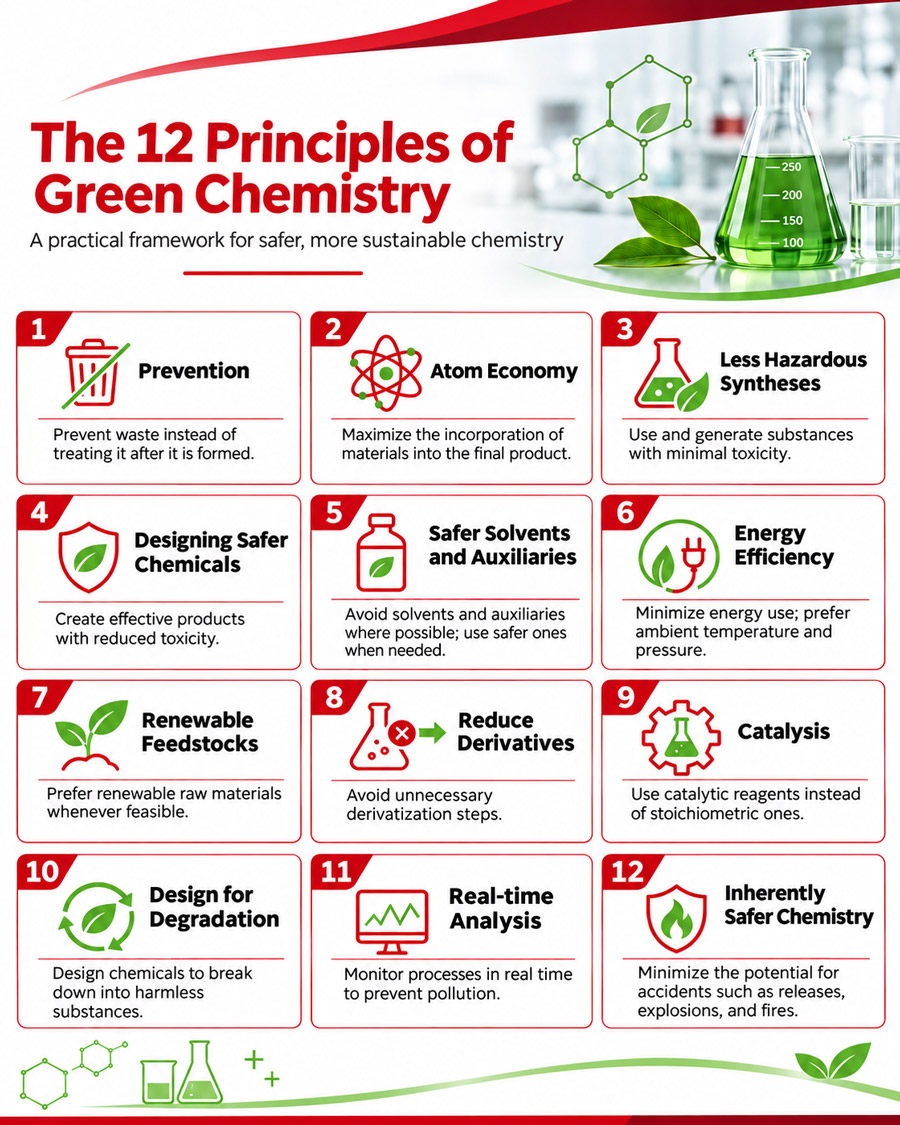
A ‘green solvent’ does not belong to a clearly defined class of chemical substances. Instead, the aim is to strike the best possible balance between technical performance, low hazard potential, minimal environmental impact, efficient use and – where appropriate – the use of renewable feedstocks.
The twelve principles offer valuable guidance. Among other things, they emphasise waste prevention, minimising energy consumption, using less hazardous chemicals and making use of renewable feedstocks. Particularly relevant to everyday laboratory practice is the principle of avoiding solvents wherever possible and choosing the least hazardous alternatives when their use is unavoidable.
Although this may sound somewhat abstract, it boils down to a simple shift in thinking in the laboratory: rather than asking only ‘Which solvent works?’, we should also ask ‘How much do I actually need – and what does my choice mean for safety, the environment and the process itself?’
Good solvents, bad solvents?
If only it were that simple. For many years, one consideration took precedence in the laboratory: a solvent had to do its job. As a result, older experimental protocols still specify substances whose use is viewed with greater concern today. Alternatives are now available for many applications, but a universal like-for-like replacement is rarely an option.
Dichloromethane is a case in point. In some chromatographic applications, ethyl acetate-based mixtures can provide a viable alternative; in others, they cannot. Similarly, toluene can replace benzene in certain applications. Although this is an improvement in terms of carcinogenicity, it hardly makes toluene harmless: it remains highly flammable and poses risks to health [2, 3]. This is why solvent selection guides are far more useful than relying on intuition alone when choosing a substitute.
There is another important consideration: changes to validated or regulated processes, in particular, may require additional feasibility studies, revalidation and approvals. The aim is therefore not to overhaul every existing process straight away. A more sensible approach is to assess them systematically: where can solvent consumption be reduced? Where is a safer alternative available? And where does the existing process, once all relevant factors have been considered, remain the better option?
Four ways to make solvent use greener
1. Avoid or reduce solvent use
The best way to deal with solvent waste is to avoid generating it in the first place. Depending on the reaction, it may be possible to work at higher concentrations, simplify work-up procedures or dispense with solvents altogether. Whether this is chemically feasible and safe must be assessed on a case-by-case basis. Resources such as the CHEM21 Solvent Selection Guide [2] can help inform these assessments and establish priorities.
2. Switch to more suitable solvents
Where a solvent is essential, it is worth systematically exploring less problematic alternatives. Ethyl lactate, for example, can be produced from renewable feedstocks and is considered readily biodegradable [5]. Cyrene (dihydrolevoglucosenone) is derived from cellulose and was developed as a bio-based alternative to dipolar aprotic solvents such as NMP or DMF. In some reactions, it has demonstrated performance comparable to that of NMP [4].
There is, however, an important caveat: even a promising solvent is not necessarily a drop-in replacement. Polarity, solubility, boiling point, viscosity, reaction kinetics and work-up requirements can differ considerably. Ultimately, it is the application that determines suitability.
3. Make effective use of renewable feedstocks
Where technically and economically feasible, green chemistry advocates the use of renewable rather than finite feedstocks [1]. The range of available bio-based solvents is growing accordingly. Suppliers such as Carl ROTH now offer these alternatives alongside other classes of solvents for green chemistry applications [7].
You can find out more about Carl ROTH’s sustainability criteria and its ROTH for Future approach on the sustainability page.
However, ‘bio-based’ describes the origin of the feedstock, not necessarily the overall environmental footprint. The production of a bio-based solvent can still require substantial amounts of energy, water or land. Depending on the feedstock, competing demands for resources may also arise, particularly in the case of crops such as maize, sugar cane or oilseed rape. Residual materials, waste streams and lignocellulosic feedstocks are therefore of particular interest. Whether a solvent offers a genuine advantage is best determined through a life cycle assessment [6].
4. Reduce hazards and environmental persistence
Being derived from biomass does not, in itself, make a solvent sustainable. Toxicity, potential long-term effects, environmental persistence and degradability are also crucial considerations. This is precisely why simple labels such as ‘green’ or ‘bio-based’ tell only part of the story.
The aim is not to find the perfect solvent – in practice, there is rarely such a thing – but to identify a demonstrably better solution for the application in question. Even a substantial reduction in solvent consumption or the replacement of a particularly problematic substance can make a tangible difference [1, 6].
What does this mean in practice?
Making solvent use more sustainable does not have to begin with a radical overhaul of laboratory processes. Often, the best starting point is a critical look at existing practices: where are particularly large quantities of solvents being used? Which substances raise concerns for human health or the environment? Where are tried-and-tested alternatives already available? And where could less solvent achieve equally good results?
With these foundations in place, we will take a more practical look at the subject in Part 2. We will explore two very different approaches to solvent use – ionic liquids and supercritical CO₂ – before showing, step by step, how to approach solvent substitution systematically in the laboratory.
Sources:
[1] American Chemical Society (ACS). „12 Principles of Green Chemistry.“ Mit den von Anastas und Warner 1998 formulierten Prinzipien; Abschnitt „Safer Solvents and Auxiliaries“. https://www.acs.org/green-chemistry-sustainability/principles/12-principles-of-green-chemistry.html
[2] Prat, D. et al. “CHEM21 Selection Guide for Classical and Less Classical Solvents.” Green Chemistry 2016, 18, 288–296. DOI: 10.1039/C5GC01008J. https://pubs.rsc.org/en/content/articlehtml/2016/gc/c5gc01008j
[3] PubChem / ECHA hazardous substance data (EU-CLP) on ethanol, dichloromethane, benzene, toluene, and N,N-dimethylformamide. https://pubchem.ncbi.nlm.nih.gov/
[4] Sherwood, J. et al. “Dihydrolevoglucosenone (Cyrene) as a bio-based alternative for dipolar aprotic solvents.” Chemical Communications 2014, 50, 9650–9652. DOI: 10.1039/C4CC04133J.
[5] Pereira, C. S. M.; Silva, V. M. T. M.; Rodrigues, A. E. “Ethyl lactate as a solvent: Properties, applications, and production processes—a review.” Green Chemistry 2011, 13, 2658–2671. DOI: 10.1039/C1GC15523G.
[6] Clarke, C. J. et al. “Green and Sustainable Solvents in Chemical Processes.” Chemical Reviews 2018, 118, 747–800. DOI: 10.1021/acs.chemrev.7b00571.
[7] Carl ROTH. “Green Chemistry” – Information and product selection, including alternative and bio-based solvents. https://www.carlroth.com/com/en/Nachhaltigkeit