


Stinging nettles vs. predators
When touching hurts
The stinging nettle (Urtica dioica) is one of the best-known wild plants in Central Europe and a prime example of plant defence mechanisms. Despite its high content of proteins, minerals and vitamins, it is shunned by many herbivores – not because of a lack of nutrients, but due to its highly effective defence strategy. For humans, this manifests as a brief stinging sensation on the skin; biologically, however, it is a finely tuned interplay of mechanical injury and chemical signalling. The stinging nettle thus provides a clear model for investigating plant defence mechanisms.
When plants defend themselves
Plants are firmly rooted in one place and cannot avoid danger. Over the course of evolution, they have therefore developed a variety of passive defence mechanisms, including thorns and toxic substances. The stinging nettle combines several strategies in a particularly efficient way. Central to its defence are specialised cell structures on the surfaces of its leaves and stems – the stinging hairs. They turn even a fleeting touch into an unpleasant experience and thus act as a deterrent to a wide range of potential herbivores.
Stinging hairs: precision instruments on a microscopic scale
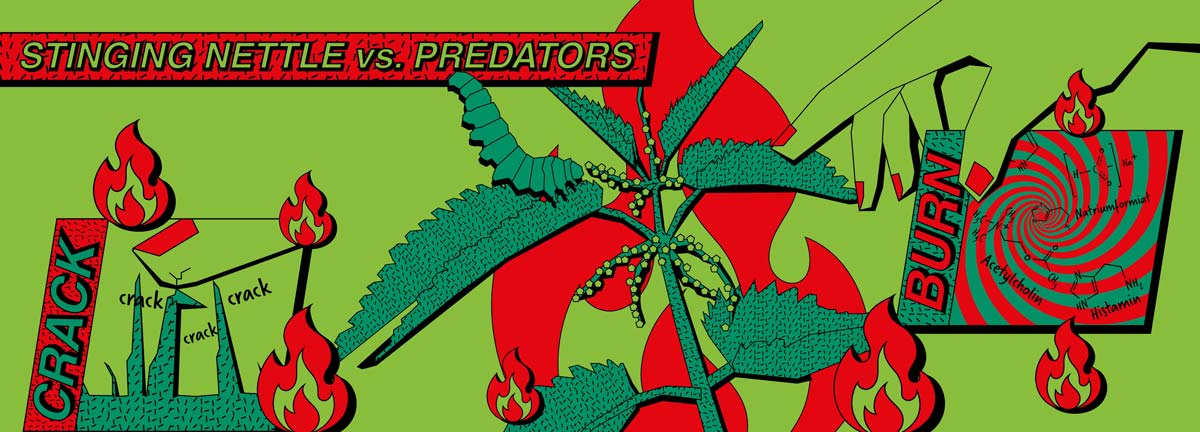
The stinging hairs of the stinging nettle consist of long, brittle protrusions with heavily silicified cell walls. At their tip is a defined predetermined breaking point. When subjected to mechanical stress, such as touch, the tip breaks off. The remaining hair acts like a fine injection needle, introducing irritant substances into the tissue. This mixture contains histamine in particular, as well as other biogenic amines such as acetylcholine and formic acid. It activates local pain receptors and inflammatory processes, leading to redness, a burning sensation and itching. Histamine increases blood flow and the inflammatory response, causing the sensation to be felt for longer. For many generalist herbivores, a single experience is enough to make them avoid stinging nettles in future. Some specialised insect species, on the other hand, have adapted to this defence mechanism and specifically use the plant as a food source.
Ecological role despite defence mechanisms
In many ecosystems, the stinging nettle has a key role, as it provides a habitat and food source for numerous insect species. Caterpillars of butterflies such as the peacock butterfly or the small tortoiseshell feed exclusively on its leaves, whilst other insects find shelter and microhabitats on the stems and within the dense foliage.
These characteristics make the plant an “ecological cornerstone”: it stabilises local food webs, supports the populations of its predators and actively contributes to biodiversity. At the same time, its effective stinging hairs prevent it from being completely grazed down by herbivores, enabling it to thrive even in nutrient-rich or heavily disturbed habitats.
From a scientific perspective, this demonstrates that defensive strategies and ecological significance are not mutually exclusive, but rather reinforce one another: the defence mechanisms prevent excessive grazing and thereby contribute to the preservation of the plant and the habitat it provides for specialised organisms.
Research and laboratory work
The stinging nettle is particularly well suited as a model system for plant defence mechanisms, as it exhibits a rare and clearly defined combination of mechanical and chemical defence strategies. The research focuses on the stinging hairs as a functional unit comprising both structure and a storage system of active compounds. Studies analyse how the high silicification of the cell walls and the defined predetermined breaking point at the tip of the hair convert mechanical stress into a targeted penetration of the herbivore’s skin. This mechanical component acts not only as a mechanism of injury, but also as a trigger for the controlled release of chemical signalling substances.
Another key area of research is chemical ecology, particularly the question of how these defensive substances influence the behaviour of herbivores in the long term. Studies show that negative sensory experiences with the stinging nettle can lead to long-term avoidance. At the same time, evolutionary biologists are investigating how specialised insect species have developed physiological, morphological or behavioural adaptations to circumvent or tolerate these defence mechanisms. The stinging nettle is well suited for studying interactions between plants and herbivores.
Beyond ecological research, however, the stinging nettle is also highly relevant to medical and pharmacological science. In particular, research here focuses on the effects of its active ingredients on inflammatory processes, vascular responses and neural signalling pathways. Experimental and clinical studies are investigating, amongst other things, the anti-inflammatory effects of nettle extracts in rheumatic and degenerative joint diseases, as well as their potential impact on blood circulation and neural processes.
For laboratory and research work: Carl ROTH offers a comprehensive range of materials and supplies.
Discover our online store at www.carlroth.com
Sources:
https://www.scinexx.de/wissenswert/frage-warum-brennen-brennnesseln
https://www.spektrum.de/lexikon/biologie/brennnessel/10614
https://www.pharmazeutische-zeitung.de/die-brennnessel-ein-kraut-mit-vielen-eigenschaften-130345