



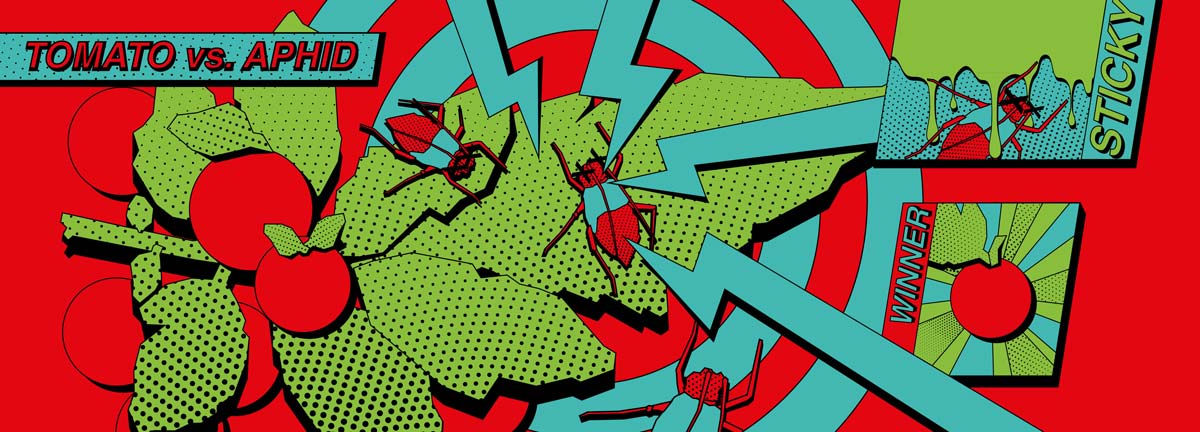
Tomato vs aphid
The sticky secret of the tomato plant
Sweet-scented, juicy and rich in valuable nutrients: tomatoes are hard to imagine leaving out of our diet. Yet humans are not the only ones to appreciate their qualities. Aphids, too, find this popular crop plant a veritable feast. Anyone who thinks the tomato is defenceless against these tiny attackers, however, underestimates its natural defence mechanisms.
A natural, sticky protective layer lies hidden on its leaves and stems. Tiny glandular hairs produce specialised sugar compounds that slow pests down and make it harder for them to find food. The layer they form acts like an invisible line of defence directly on the plant surface.
There is far more behind this mechanism than a simple plant coating. It is the product of a remarkable evolutionary development and demonstrates how plants use chemical processes to protect themselves against herbivores.
The invisible guardians on the leaf
To an aphid, a tomato leaf may at first appear to be the perfect landing site. In reality, however, the plant surface is anything but unprotected. Under the microscope, it reveals a landscape of minute hairs densely covering leaves and stems. These so-called trichomes are more than just a detail of the plant surface.
Some of these fine structures help the tomato conserve water or protect itself from intense sunlight. Others form a first line of defence against pests. Of particular importance are the glandular trichomes: at their tips they produce and store a range of chemical compounds that are deployed when something lands on the plant’s leaves or stems.
For small insects, the tomato plant’s surface quickly becomes an obstacle course. The fine hairs impede movement and bring pests into direct contact with the plant’s defensive compounds. The real speciality, however, lies in a sticky secretion produced by the glandular hairs. Instead of thorns or spines, the plant uses an inconspicuous weapon precisely where contact begins. And, remarkably, sugar becomes an almost insurmountable barrier for many aphids on their way to a coveted meal.
When sugar becomes a trap
For an aphid, the challenge begins immediately after landing. Where it tries to find a firm foothold, it encounters an adhesive secretion. The reason lies in a special group of compounds known as acyl sugars
From a chemical perspective, these molecules consist of sugar building blocks linked to fatty acids. They are produced directly in the plant’s glandular trichomes, where they accumulate in high concentrations. Acyl sugars are key constituents of the adhesive secretions designed to restrict the mobility of small insects.
What is striking is the efficiency of the system. The plant does not have to distribute large quantities of these substances throughout all its tissues. Instead, they are produced specifically at the surface, exactly where potential attackers first arrive. Chemical defence is therefore closely linked to the architecture of the plant.
Attack slowed down
For an aphid, the challenge begins immediately after landing. Where it tries to find a firm foothold, it encounters an adhesive secretion. The reason lies in a special group of compounds known as acyl sugars.
As soon as an aphid lands on a leaf and searches for a suitable site to tap into the plant cells, the delicate tips of the glandular hairs may be damaged. The secretion stored inside is released in an instant, forming an adhesive layer that fixes the aphid to the plant like a kind of superglue. Small insects such as aphids stick to it directly; some die on the spot, while others become easy prey for their natural enemies.
Aphids are by no means the tomato’s only potential pests. Whiteflies, thrips and other herbivorous insects can also be trapped by trichome secretions. The sticky protective layer can therefore slow down a whole range of potential attackers at the very first point of contact with the plant.
The adhesive secretion does more than make feeding difficult for herbivores. If aphids are less able to establish themselves on the plant, this can also limit their reproduction and therefore further colonisation of the tomato.
What researchers can learn from the tomato
The tomato shows just how much innovative potential is contained in natural protective mechanisms. In laboratories around the world, scientists are working to decipher these processes and make the insights gained useful for research and practice. Acyl sugars are of particular interest to researchers because they show how plants can develop complex defence mechanisms from comparatively simple chemical building blocks. At the same time, they provide valuable clues as to how natural defence strategies might in future be used in sustainable crop protection concepts.
Using modern analytical techniques, scientists investigate how adhesive acyl sugars are synthesised in the plant and what role they play in pest defence. Studies show, for example, that tomato lines with higher concentrations of certain acyl sugars can slow pests particularly effectively on the plant surface.
One observation is especially relevant for plant breeding: wild tomatoes often produce significantly higher amounts of these protective substances than many modern cultivated varieties.
The findings could in future help to develop more resistant crop plants and selectively strengthen natural protection mechanisms. Recent research from the Universities of Hohenheim and Tübingen shows, for instance, that signalling molecules such as the peptide systemin are involved in activating defence responses during insect attack. Scientists have also already succeeded in reconstructing acyl sugar biosynthesis in vitro in the laboratory.
Supporting science. Improving lives.
Turning observations into reliable results takes curiosity, advanced analytical methods and laboratory solutions researchers can trust. Carl ROTH supports scientific work with carefully selected, high-quality chemicals, laboratory supplies, consumables and solutions for analysis, research and plant science – enabling teams to work efficiently, safely and with confidence.
From sample preparation and microscopy to reagents, protective equipment and everyday laboratory essentials, the Carl ROTH online shop offers a comprehensive range for modern research environments. Fast availability, dependable product quality and expert technical advice make Carl ROTH a strong partner for laboratories that want to move their projects forward.
Find the right products and solutions for your laboratory at www.carlroth.com.
Sources:
Spektrum der Wissenschaft: Trichome. Lexikon der Biologie.
https://www.spektrum.de/lexikon/biologie/trichome/67515
Spektrum der Wissenschaft: Pflanzenhaare. Kompaktlexikon der Biologie.
https://www.spektrum.de/lexikon/biologie-kompakt/pflanzenhaare/8881
Pflanzenforschung.de: Den Tomaten abgeguckt – Substanz zur Abwehr von Fraßfeinden im Labor nachgebaut. 10. Februar 2016.
https://www.pflanzenforschung.de/de/pflanzenwissen/journal/den-tomaten-abgeguckt-substanz-zur-abwehr-von-frassfein-10575
Pflanzenabwehr: Natürliche Schutzmechanismen gegen Fraßfeinde
https://www.pflanzenforschung.de/de/home
J. Glas et al., 2012, Plant Glandular Trichomes as Targets for Breeding or Engineering of Resistance to Herbivores. International Journal of Molecular Sciences, 13:17077–17103
https://doi.org/10.3390/ijms131217077
Universität Tübingen / Universität Hohenheim: Cell-Publikation: So regulieren Pflanzen ihre Abwehr. 22. August 2025.
https://uni-tuebingen.de/universitaet/aktuelles-und-publikationen/pressemitteilungen/newsfullview-pressemitteilungen/article/cell-publikation-so-regulieren-pflanzen-ihre-abwehr/
J. Popowski et al., 2025, Glandular trichome rupture in tomato plants is an ultra-fast and sensitive defense mechanism against insects. Journal of Experimental Botany, 76: 6508–6519
https://academic.oup.com/jxb/article/76/21/6508/8159201
How does the tomato protect itself against aphids?
Tomatoes have fine plant hairs, known as trichomes, on their leaves and stems. Some of these are glandular hairs that produce specialised substances such as acyl sugars. These form a sticky protective layer on the plant surface and can slow aphids and other small pests in their movement and feeding behaviour.
What are trichomes in tomato plants?
Trichomes are tiny hairs on the surface of plants. In tomatoes, they mainly cover the leaves and stems. Some trichomes help protect the plant from sunlight or water loss, while others play an important role in defence against pests.
What are acyl sugars?
Acyl sugars are natural plant compounds made up of sugar building blocks and fatty acids. In tomatoes, they are formed in certain glandular trichomes. On the plant surface, they help create a sticky protective layer that can slow pests down when they come into contact with the plant.
Why do aphids get stuck on tomato plants?
Aphids can have their movement restricted by the sticky secretions of glandular hairs. When the delicate glandular hairs are damaged, stored substances may be released. This makes the plant surface difficult for small insects to move across.
Are acyl sugars a natural insecticide?
Acyl sugars do not act like conventional insecticides designed to kill pests directly. They are part of the plant’s natural defence system. Their effect is based mainly on slowing insects down on the plant surface, making feeding more difficult and potentially reducing infestation.
Can tomato plants defend themselves against pests?
Yes. Tomato plants possess various natural protective mechanisms. These include trichomes, glandular hairs, sticky secretions and chemical signalling pathways that can be activated during insect attack. Together, these mechanisms help the plant protect itself against aphids, whiteflies, thrips and other pests.
What makes wild tomatoes interesting for research?
Wild tomatoes often produce higher amounts of certain protective substances than many modern cultivated varieties. This makes them particularly interesting for plant research and breeding. Researchers are investigating how natural defence mechanisms can be used selectively to develop more resistant crops.
What is the significance of tomato defence for sustainable crop protection?
The tomato’s natural defence mechanisms show how plants can slow pests down without conventional chemical crop protection products. This knowledge may help develop new approaches to sustainable crop protection, robust crops and more resource-efficient cultivation methods.
Which pests respond to the tomato’s protective substances?
Alongside aphids, other small herbivorous insects such as whiteflies or thrips can be affected by substances produced by glandular hairs. The sticky protective layer acts directly on the plant surface, precisely where many pests first come into contact with the plant.
Why is research into trichomes and acyl sugars important?
Research into trichomes and acyl sugars helps us understand how plants use their surface as an active protective barrier. In the long term, these insights may contribute to advances in plant breeding, agricultural research and sustainable crop protection.