

Uranium
A fine line between saving lives and overkill
Attacks on Iranian nuclear facilities, disputes over access for inspections and debates about highly enriched uranium have brought the issue of geopolitical risks back into the public eye with renewed intensity.
Nuclear reactors are operated for peaceful electricity generation in 31 countries around the world [1]. In June 2025, the International Atomic Energy Agency (IAEA) reported that, as of 13 June 2025, Iran possessed 440.9 kg of uranium in the form of UF₆, enriched to up to 60 per cent U-235 – a stockpile considered highly sensitive from a security perspective [2–4].
This highlights the central dilemma in dealing with uranium: the element is not, in itself, a military material. It only becomes a key issue in security policy because of its degree of enrichment. There is no fundamentally different material lying between civilian use and military escalation; rather, there is a gradual technological process [3,5].
An element from the actinide series
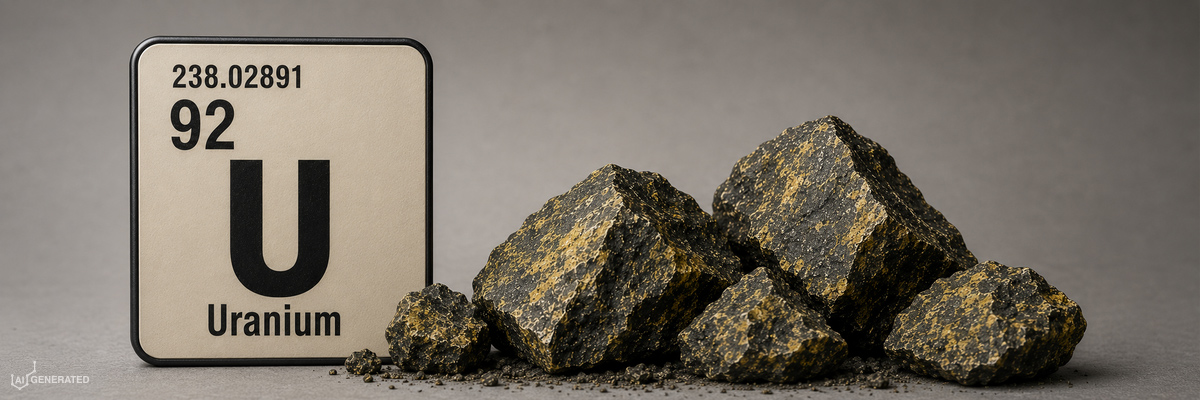
Uranium is a chemical element with atomic number 92 and belongs to the actinides in the periodic table. It is a dense, naturally occurring radioactive heavy metal. Its density is around 19.1 g/cm³, which is significantly higher than that of lead [6,7]. In natural uranium, approximately 99.27 per cent is uranium-238, around 0.72 per cent is uranium-235 and only traces are present of uranium-234. For many technical applications, particularly in light-water reactors, the natural U-235 content is too low and must be increased through technical processes [5,7,8].
Production and supply chains
Mining marks the start of the uranium supply chain. Uranium ore is mined, processed and converted into uranium oxide concentrate (“yellowcake”). The term “yellowcake” primarily refers to a powdered mixture of uranium oxide that is produced as an intermediate product during uranium processing and which, depending on its composition, can range in colour from yellowish to dark green or black. It is mildly radioactive, highly chemically toxic and serves as the feedstock for manufacturing fuel elements. For further use, this material is converted into uranium hexafluoride (UF₆) and subsequently enriched [5,8].
In 2024, the largest producers of mined uranium were Kazakhstan, Canada and Namibia. Enrichment plants are located in Europe, the USA and Russia, amongst other places.
Enrichment: a key technology with dual benefits
The key technology in the uranium fuel cycle is isotope separation. On an industrial scale, this is now predominantly carried out using gas centrifuges. Inside the rotating centrifuge, the uranium hexafluoride molecules containing U-235 are distributed slightly differently from those containing U-238 due to their lower mass. A single centrifuge achieves only a very small degree of separation; it is only cascades comprising many centrifuges that gradually increase the proportion of U-235 [5,9].
For most nuclear power stations, low-enriched uranium (LEU), typically containing three to five per cent U-235, is sufficient. By definition, highly-enriched uranium (HEU) begins at a U-235 content of over 20 per cent. In practice, weapons-grade material is usually in the range of 90 per cent and above [5]. The enrichment process also produces DU (depleted uranium), which consists almost exclusively of uranium-238 [5,8,10].
Energy generation: high output, long-term responsibility
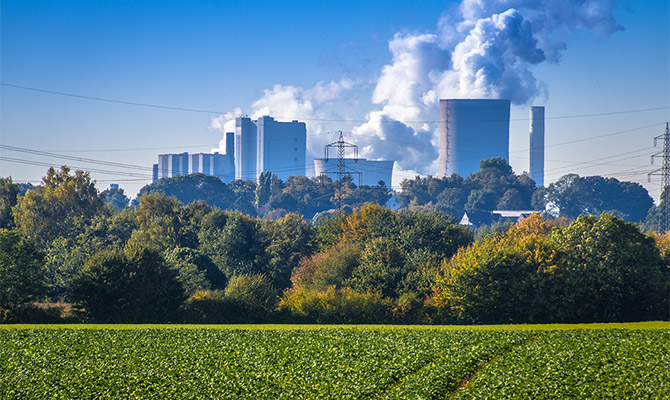
Nuclear power stations use the controlled fission of uranium-235. The energy released in this process heats water, generates steam and drives turbines. The major advantage of this process lies in its high energy density:
even a comparatively small amount of fuel can provide enormous quantities of energy [8,11]. The downside of nuclear energy is radioactive waste.
Spent fuel elements and other highly radioactive residues must be stored safely over the long term. In technical jargon, these are referred to as interim storage facilities and – in the future – deep geological repositories. It is precisely this long-term responsibility that is a key point of contention in the assessment of nuclear energy [12,13].
Medicine: the invisible driving force behind modern diagnostics
In nuclear medicine, uranium does not play a direct role as an active substance, but it is a key starting point for the production of important radioisotopes. For medical applications, enriched uranium or reactor material is primarily used in specialised research and isotope production reactors [14,21]. In research and isotope production reactors, targets are irradiated to produce, amongst other things, molybdenum-99. This decays into technetium-99m (Tc-99m), the world’s most important diagnostic nuclide in medical imaging. Tc-99m is used in millions of examinations of the heart, bones, kidneys and tumours [14,15].
The field has also advanced in the therapeutic area. Targeted alpha therapy utilises alpha emitters that can damage tumour tissue highly locally and effectively. These processes are not “uranium therapies” in the strict sense, but they fall within the same nuclear technology context of isotope extraction and utilisation [16].
Research: neutron source and geological time scale
As well as in energy and medicine, uranium is an important material for research Research reactors supply neutrons for materials research, materials testing and isotope production. Such sources are of key importance, particularly in analytical chemistry and materials science [14]. Furthermore, uranium is a vital tool in the geosciences: the uranium-lead dating system is one of the most precise methods for determining the age of rocks and minerals, enabling conclusions to be drawn about time periods ranging from hundreds of millions to billions of years [7].
Waste disposal: different problems, different time horizons
The issue of radioactive waste disposal must be considered in a nuanced way. The energy sector generates highly radioactive waste with very long time horizons. In medicine, on the other hand, the waste produced is predominantly low- to medium-level radioactive and often short-lived. Some of these materials can be released from the controlled area after a defined period of storage, once their radioactivity has decayed. Detailed international safety standards exist for this purpose in medical applications [12,13,17]. The concern, often expressed in general terms, is that every nuclear application inevitably leads to unmanageable waste problems is therefore not tenable from a technical point of view. However, it is all the more justified where long-lived, highly radioactive materials are produced or where safety and disposal regimes are inadequate [12,17].
Risks and public perception
The public debate on uranium is often characterised by extremes: ranging from demonisation to trivialisation. In fact, the risks are highly context-dependent. In medicine and industry, the handling of radioactive substances is strictly regulated; international standards govern radiation protection, waste management and quality assurance [17,18]. The situation is different when it comes to military use and proliferation issues. Here, the concern is not with controlled applications, but with the possibility of using enrichment technologies to produce weapons-grade material.
Even depleted uranium is not a harmless by-product: it is mildly radioactive and, above all, chemotoxic. When used in munitions, inhalable particles can be produced. The WHO and the IAEA assess the risks in a nuanced manner: health risks cannot be ruled out, but depend significantly on the type and extent of exposure [10,19,20].
Conclusion: differentiation rather than demonisation
Uranium is not a monolithic substance, but a technologically highly differentiated material. Its uses range from life-saving diagnostics to energy supply and military applications. What matters is not the element in itself, but the context in which it is used – in particular, the degree of enrichment and the quality of the safety and control regimes. It is therefore crucial to focus the discussion on the right issues: when we talk about uranium, we are talking less about a substance and more about how a society deals with advanced technology.
Sources:
[1] World Nuclear Association. Plans For New Reactors Worldwide [Internet]. London: WNA; 2026 [zitiert am 1.Juni 2026]. Verfügbar unter: https://world-nuclear.org/information-library/current-and-future-generation/plans-for-new-reactors-worldwide
[2] International Atomic Energy Agency. Verification and monitoring in the Islamic Republic of Iran in light of United Nations Security Council resolution 2231 (2015) [Internet]. Wien: IAEA; 2025 [zitiert am 15. Apr. 2026]. Verfügbar unter: https://www.iaea.org/sites/default/files/documents/gov2025-50.pdf
[3] International Atomic Energy Agency. Statement on the situation in Iran [Internet]. Wien: IAEA; 13. Juni 2025 [zitiert am 15. Apr. 2026]. Verfügbar unter: https://www.iaea.org/newscenter/statements/statement-on-the-situation-in-iran-13-june-2025
[4] International Atomic Energy Agency. Director General Grossi’s statement to UNSC on situation in Iran [Internet]. Wien: IAEA; 13. Juni 2025 [zitiert am 15. Apr. 2026]. Verfügbar unter: https://www.iaea.org/newscenter/statements/director-general-grossis-statement-to-unsc-on-situation-in-iran-13-june-2025
[5] World Nuclear Association. Uranium enrichment [Internet]. London: WNA; 2025 [zitiert am 15. Apr. 2026]. Verfügbar unter: https://world-nuclear.org/information-library/nuclear-fuel-cycle/conversion-enrichment-and-fabrication/uranium-enrichment
[6] Royal Society of Chemistry. Uranium [Internet]. London: RSC; [zitiert am 15. Apr. 2026]. Verfügbar unter: https://periodic-table.rsc.org/element/92/uranium
[7] Bundesamt für Strahlenschutz. Uran [Internet]. Salzgitter: BfS; [zitiert am 15. Apr. 2026]. Verfügbar unter: https://www.bfs.de/DE/themen/ion/wirkung/radioaktive-stoffe/uran/uran_node.html
[8] World Nuclear Association. How is uranium made into nuclear fuel? [Internet]. London: WNA; 2025 [zitiert am 15. Apr. 2026]. Verfügbar unter: https://world-nuclear.org/nuclear-essentials/how-is-uranium-made-into-nuclear-fuel
[9] World Nuclear Association. Uranium and depleted uranium [Internet]. London: WNA; 2025 [zitiert am 15. Apr. 2026]. Verfügbar unter: https://world-nuclear.org/information-library/nuclear-fuel-cycle/uranium-resources/uranium-and-depleted-uranium
[10] World Nuclear Association. High-assay low-enriched uranium (HALEU) [Internet]. London: WNA; 2026 [zitiert am 15. Apr. 2026]. Verfügbar unter: https://world-nuclear.org/information-library/nuclear-fuel-cycle/conversion-enrichment-and-fabrication/high-assay-low-enriched-uranium-haleu
[11] International Atomic Energy Agency. How research reactors help make medical imaging possible [Internet]. Wien: IAEA; [zitiert am 15. Apr. 2026]. Verfügbar unter: https://www.iaea.org/bulletin/how-research-reactors-help-make-medical-imaging-possible
[12] International Atomic Energy Agency. Management of radioactive waste from the use of radionuclides in medicine [Internet]. Wien: IAEA; 2000 [zitiert am 15. Apr. 2026]. Verfügbar unter: https://www-pub.iaea.org/MTCD/Publications/PDF/te_1183_prn.pdf
[13] International Atomic Energy Agency. Storage of radioactive waste. Specific Safety Guide No. SSG-15 [Internet]. Wien: IAEA; 2006 [zitiert am 15. Apr. 2026]. Verfügbar unter: https://www-pub.iaea.org/MTCD/Publications/PDF/Pub1254_web.pdf
[14] International Atomic Energy Agency. Exploring research reactors and their use [Internet]. Wien: IAEA; [zitiert am 15. Apr. 2026]. Verfügbar unter: https://www.iaea.org/bulletin/exploring-research-reactors-and-their-use
[15] International Atomic Energy Agency. Developing techniques for small scale indigenous molybdenum-99 production [Internet]. Wien: IAEA; [zitiert am 15. Apr. 2026]. Verfügbar unter: https://www.iaea.org/projects/crp/t12018
[16] Parker C et al. Targeted alpha therapy, an emerging class of cancer agents: a review. JAMA Oncol. 2020;6(11):1765–1772. doi:10.1001/jamaoncol.2018.4044
[17] International Atomic Energy Agency. Radiation protection and safety in medical uses of ionizing radiation. Specific Safety Guide No. SSG-46 [Internet]. Wien: IAEA; 2018 [zitiert am 15. Apr. 2026]. Verfügbar unter: https://www-pub.iaea.org/MTCD/Publications/PDF/PUB1775_web.pdf
[18] International Atomic Energy Agency. Radiation protection of patients [Internet]. Wien: IAEA; [zitiert am 15. Apr. 2026]. Verfügbar unter: https://www.iaea.org/resources/rpop
[19] World Health Organization. Depleted uranium: sources, exposure and health effects [Internet]. Genf: WHO; 2001 [zitiert am 15. Apr. 2026]. Verfügbar unter: https://www.who.int/publications/i/item/WHO-SDE-PHE-01.1
[20] Bleise A. et al., Properties, use and health effects of depleted uranium (DU): a general overview. J Environ Radioact. 2003;64(2-3):93–112. Verfügbar unter: https://www.iaea.org/sites/default/files/properties.pdf
[21] World Nuclear Association. World uranium mining production [Internet]. London: WNA; 2026 [zitiert am 15. Apr. 2026]. Verfügbar unter: https://world-nuclear.org/information-library/nuclear-fuel-cycle/mining-of-uranium/world-uranium-mining-production